

A quieter period can leave you wondering whether your relationship is changing temporarily or whether you want different futures. Less conversation, less sex or more time apart does not settle that question on its own. The context, your agreements and each person’s wishes matter.
Instead of trying to diagnose the relationship from a list of signs, use the questions below to prepare an honest conversation. You may discover a problem you both want to address, a difference you can accommodate or a relationship you no longer want to continue.
On this page
1. What has actually changed?
Describe the difference as specifically as you can. “We have stopped eating together most evenings” gives you a clearer subject than “We are drifting apart.” Note when you first noticed it and what else was happening at the time.
Work, grief, illness, caring responsibilities and financial pressure may affect the time and energy available for a relationship. Ask about the situation rather than assuming an explanation. Knowing there is a stressor can help you consider support, but it does not mean every hurtful action must be accepted.
Consider your own experience too. Do you miss something you both used to enjoy, feel relieved by time apart, or want a different kind of connection? You can have mixed feelings without having an immediate answer about staying.

2. Can you discuss the distance respectfully?
Choose a time when you can focus and make the opening specific: “I have missed our conversations lately. How has the relationship been feeling to you?” Leave room for an answer that differs from your interpretation.
The NHS guide to maintaining healthy relationships discusses listening, clarification and taking a pause when an argument becomes difficult to manage calmly. Agree when you will return to a paused conversation so the subject does not simply disappear.
Notice the response over time. An awkward first conversation is different from repeatedly refusing any discussion, blaming you for every problem or punishing you for raising a need. If you fear threats or retaliation, seek confidential individual support rather than relying on a joint discussion to resolve it.
3. How are responsibilities being handled?
Discussing who does what is not evidence that love has failed. It may be the conversation you need, especially if one person is carrying tasks the other does not see.
List the practical work involved: paid work, appointments, household tasks, childcare, planning and keeping track of deadlines. Then ask what each person can realistically take responsibility for. Include the thinking and organising, not just the final visible action.
Fairness may change with health, capacity or circumstances. A useful agreement makes that change explicit instead of leaving one person to guess. Compare whether a plan is working, rather than using a running score to decide who cares more.
4. What does each person want next?
Talk about the decisions that are actually relevant: commitment, living arrangements, children, location, finances or the amount of time you want together. A relationship does not need the same milestones as someone else’s, but you do need to understand the choices each person is making.
One partner may want marriage while the other does not, or one may be uncertain about continuing at all. Clarify whether an answer means “not now,” “I do not know” or “I do not want that.” These are different positions.
Imagining a life apart is not an automatic verdict. It can help you understand your wishes and practical options. You do not have to prove that the relationship is beyond repair before deciding it is not right for you.
5. Is there a change you both want to try?
If you both want to continue, choose one or two specific changes. You might arrange time together, redistribute a task or set a regular conversation about how things are going. Choose a time to review whether the plan helped rather than setting a deadline for someone’s feelings to change.
At the review, ask what each person actually did, what became easier and what still feels unresolved. Promises matter less if the same agreement is repeatedly ignored. Counselling can be considered if both people want support and can participate freely.
There is no rule that every distant period will pass or that commitment guarantees repair. You can try a change, ask for more time or choose to leave. The purpose of these questions is to make your next step more informed, not to tell you which outcome to choose.
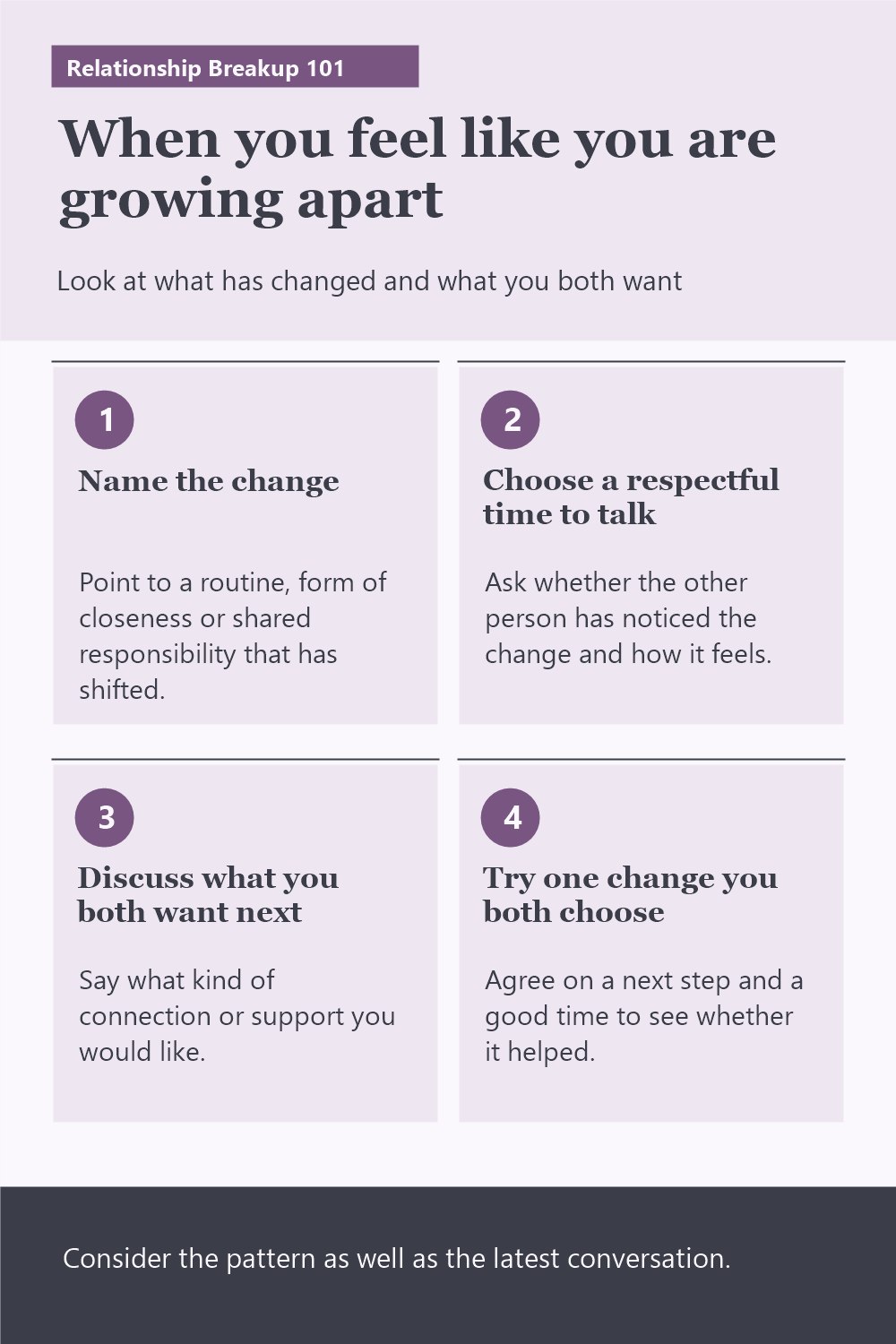
Read the infographic in text
When you feel like you are growing apart
Look at what has changed and what you both want
- Name the change Point to a routine, form of closeness or shared responsibility that has shifted.
- Choose a respectful time to talk Ask whether the other person has noticed the change and how it feels.
- Discuss what you both want next Say what kind of connection or support you would like.
- Try one change you both choose Agree on a next step and a good time to see whether it helped.
Consider the pattern as well as the latest conversation.