

If your relationship feels stressful, start with what is happening rather than deciding which person deserves a label. Repeated arguments, unequal responsibilities, uncertainty, money worries or a lack of privacy can create very different problems. Each calls for a more specific response than simply trying harder.
You can care about a partner and still need rest, independence or a change in the relationship. Notice what you can discuss and choose freely, what keeps repeating, and whether you feel safe. You do not have to accept blame for another person’s controlling behaviour.
On this page
Name the pressure in concrete terms
Choose a recent example. Perhaps messages interrupt your work, every disagreement lasts for hours, or you are doing most of the household tasks. Describe the action and its effect: “I am losing sleep because we keep restarting this conversation after midnight.”
Separate recurring patterns from a difficult week. Illness, work changes or caring responsibilities can put pressure on both people. Those circumstances deserve practical attention; they do not make insults, intimidation or forced access to your phone acceptable.
Distinguish support from taking over responsibility
Ask what help you are actually able and willing to offer. Listening for a while, sharing a task or helping someone find a service can be caring. Being responsible for solving every problem or preventing every unhappy feeling is a different expectation.
Dependence is not automatically a problem. Disability, illness, parenting and financial circumstances can involve significant support needs. Look at whether those needs and your limits can be discussed respectfully, and whether additional assistance could make care more sustainable.
Choose one limit you can explain clearly
Make the limit concrete: “I can talk until nine, then I need to sleep,” or “I am not willing to share my passwords.” Where appropriate, add what you can offer instead. A useful boundary describes your availability and actions; it is not a way to control a partner’s feelings or friendships.
Watch the response over time. A respectful partner may feel disappointed or need clarification. Repeated pressure, punishment or threats are reasons to seek support, rather than assuming you need a more persuasive script. Do not test a boundary alone if you are afraid of retaliation.

Make room for interests and other connections
Identify one connection or activity you would like to maintain: a friend, a hobby, an appointment or quiet time by yourself. Talk about the practical arrangements if it feels safe. Costs, accessibility, work and caring schedules may affect what is possible.
Keeping your own interests does not require pretending that a relationship has no responsibilities. The aim is a workable balance, with room for both people’s needs. The NHS relationship guidance includes ideas about boundaries, communication and support.
Ask for help matched to the actual problem
A trusted person may help you see a pattern or make a practical arrangement. A qualified counsellor may help you sort through feelings and choices. Support with housing, money or care can matter too; a conversation alone cannot solve a shortage of resources.
Tell a helper what you need: support setting a limit, understanding your options or planning to leave. You do not have to promise to stay together in order to ask for help. Where there is abuse or control, consider individual specialist support before arranging a joint confrontation.
Review what changes, and what you want
Choose a realistic point to review a specific agreement, if you want to try one. Look for actions: are tasks shared as agreed, is a request for rest respected, and can a disagreement end without punishment? An apology can matter, but it does not replace a change in the pattern.
You can decide that you no longer want the relationship, even if there are also good moments. If leaving feels complicated, focus on support and the next practical step. If you are worried about threats, monitoring or retaliation, the related guide below discusses safety and sources of help.
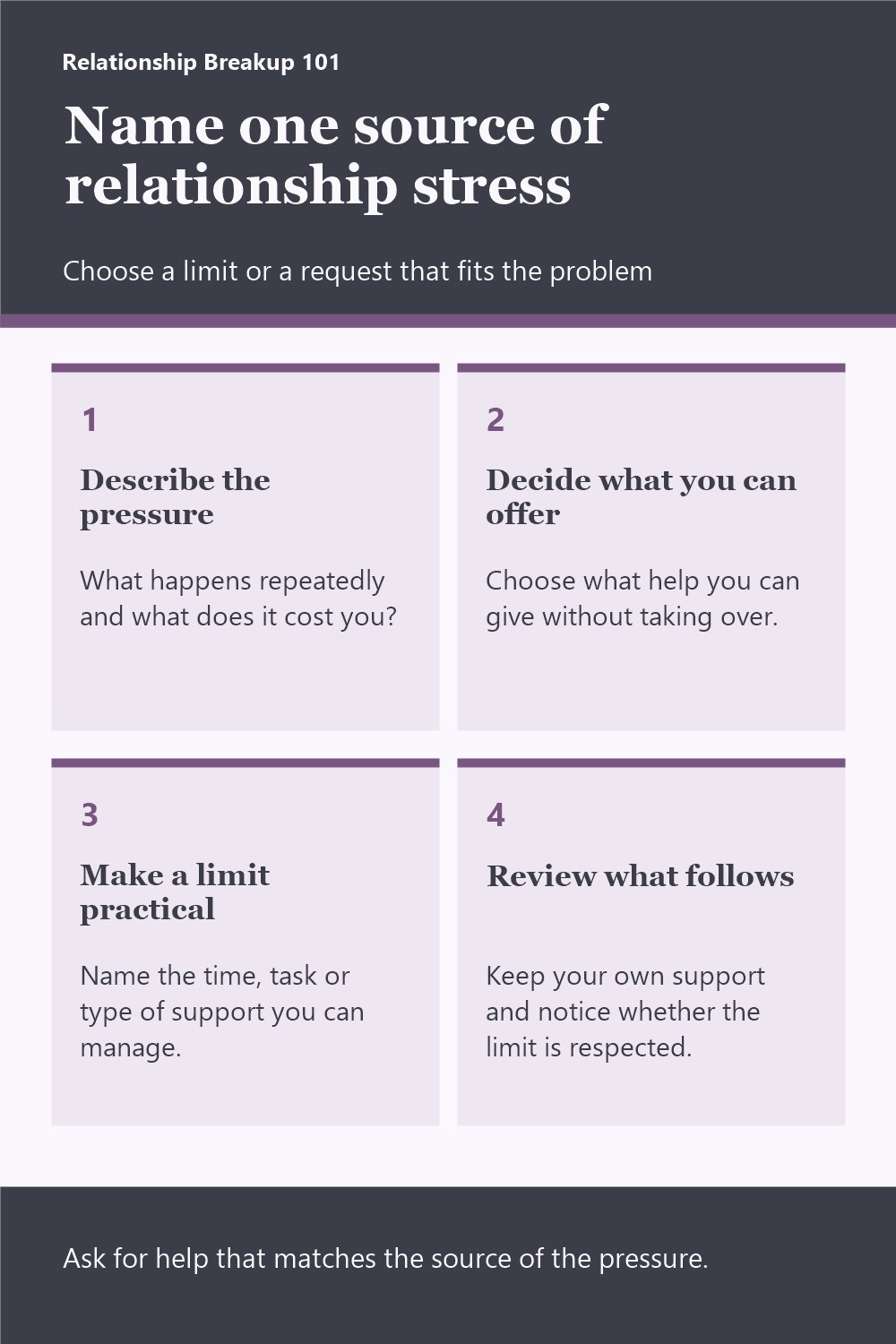
Read the infographic in text
Name one source of relationship stress
- Describe the pressure What happens repeatedly and what does it cost you?
- Decide what you can offer Choose what help you can give without taking over.
- Make a limit practical Name the time, task or type of support you can manage.
- Review what follows Keep your own support and notice whether the limit is respected.
Ask for help that matches the source of the pressure.