

Showing interest can be straightforward: suggest a plan, start a conversation or say that you would like to see someone again. Chasing becomes a concern when you keep trying to overcome a refusal, carry every interaction or put your own life on hold for an answer.
You do not have to decide what someone secretly feels before stepping back. Consider what they have said, what they are actually offering and whether the arrangement works for you.
On this page

1. A clear answer deserves respect
If someone declines a date, asks for no contact or blocks you, stop pursuing them. Do not switch accounts, recruit friends to ask for you or appear somewhere to change their mind. Interest needs room to be freely returned.
A vague or unanswered invitation can feel harder to interpret. If there has been no refusal and you genuinely need to clarify a plan, one brief follow-up may be reasonable. Repeated messages cannot create a mutual decision, and you can make other plans without diagnosing the silence.
2. The pattern of effort matters
Look at a pattern rather than a single slow reply. Does the other person ever initiate contact, suggest a plan or offer another time when they are unavailable? Are agreements usually followed through?
People have different schedules and ways of communicating. You can ask about those differences without keeping a score of every message. The useful question is whether there is a form of contact that both people want and can sustain.
3. You cannot persuade someone into the relationship you want
Being more available, buying gifts or doing favours does not establish that someone wants to date or commit. Generosity is easier to evaluate when it is offered freely rather than used to earn a particular response.
If you want clarity, try: “I enjoy spending time with you and would like to date. Is that something you want too?” Listen to the answer they give now instead of treating it as a challenge to become more convincing.
4. Your own preferences still belong in the decision
It is easy to focus on being chosen and forget to ask what you are choosing. Do you enjoy the contact you actually have? Can you make a request or decline a plan without worrying that any limit will end the connection?
Write down what you want from dating, such as consistent plans, a casual arrangement or a committed relationship. You can like someone and still decide that what they are offering does not meet your needs. That decision does not require a verdict on their character.
5. Stepping back gives ordinary life some room
If checking for replies is taking over your day, make the next step practical: mute notifications, arrange time with a friend or return to something you have postponed. You do not need to announce a dramatic withdrawal or try to make the other person miss you.
Let the space be for your own time and choices. It may feel disappointing for a while, and stepping back does not guarantee a new relationship. You can leave a door closed, or respond to future contact only if it becomes something you genuinely want.
Read the infographic in text
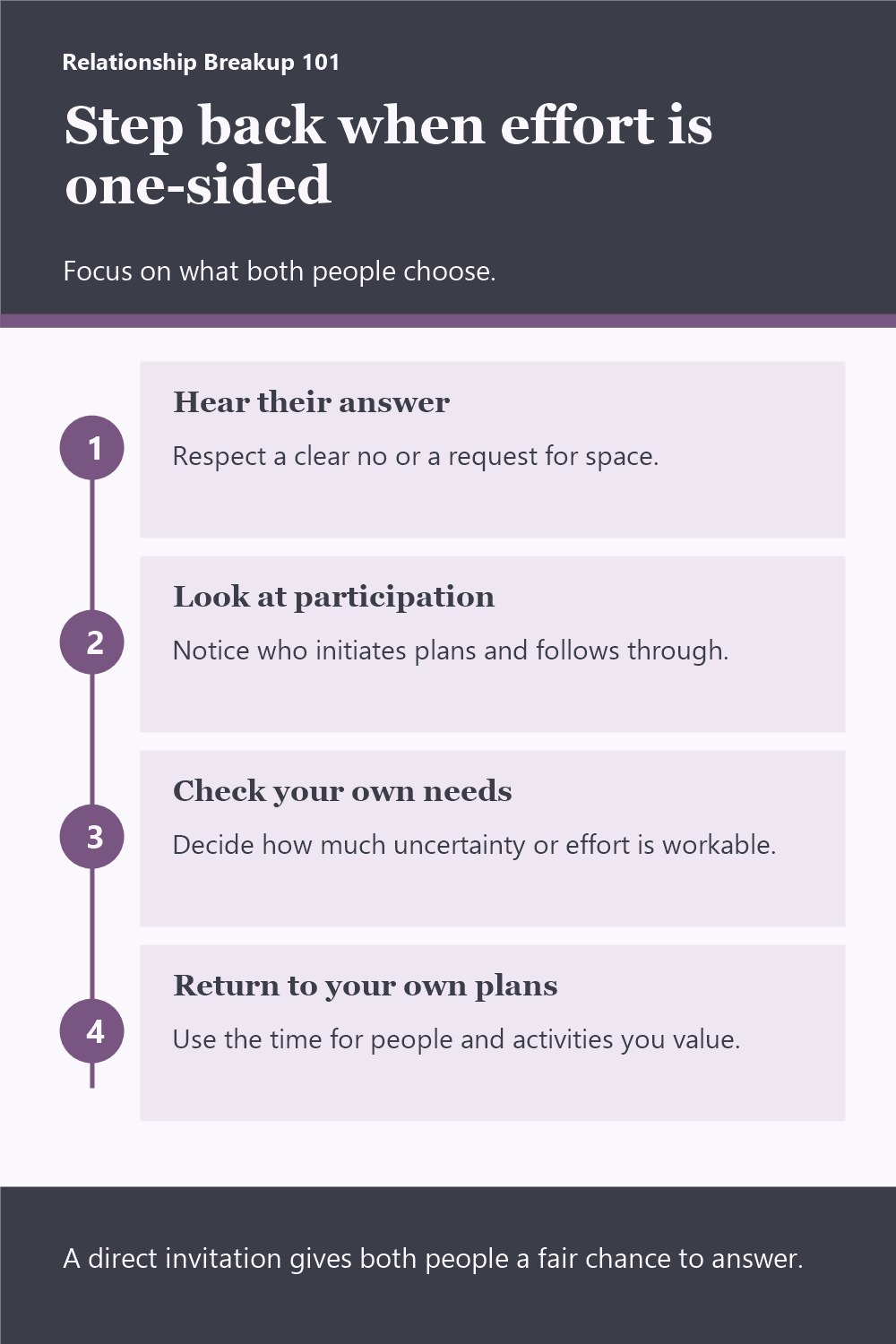
Step back when effort is one-sided Focus on what both people choose.
- Hear their answer Respect a clear no or a request for space.
- Look at participation Notice who initiates plans and follows through.
- Check your own needs Decide how much uncertainty or effort is workable.
- Return to your own plans Use the time for people and activities you value.
A direct invitation gives both people a fair chance to answer.