

Being close to someone does not mean becoming the same person. You can share a life while keeping your own interests, friendships, private thoughts and choices. You can also need care or assistance without losing the right to make decisions.
Independence works best alongside consideration. Talk about what affects each of you, how shared responsibilities will be handled and what kind of support is welcome, rather than treating closeness and autonomy as opposing goals.
On this page
- Let privacy and honesty work together
- Make space for an interest that belongs to you
- Describe alone time clearly
- Keep friendships without making them a test of loyalty
- Respect a no and leave room for feelings
- Pursue goals while discussing their shared effects
- Keep your identity and stay open to reasonable change
Let privacy and honesty work together
You do not have to share every password, message, memory or painful experience to prove trust. Choose what you want to discuss and when you feel ready. Privacy does not have to be a strategy for keeping someone interested.
Be honest about matters that affect shared choices or agreements. You might say, “I am not ready to discuss that experience, but I can tell you what support would help now.” A boundary can make room for a conversation without giving access to everything.

Make space for an interest that belongs to you
Choose something you enjoy, whether it is a class, a creative project, a sport, reading or time in a community group. Your partner does not have to share the activity for it to matter to you.
Consider the practical arrangements: cost, time, transport and any responsibilities someone else would need to cover. Discuss those effects and look for a fair arrangement, rather than assuming that having an interest means ignoring the other person’s needs.
Describe alone time clearly
“I would like an hour to myself after work” is easier to understand than disappearing or saying that you need a break without explaining what you mean. Talk about when you want to reconnect and what contact feels manageable.
Time alone is different from ending the relationship or agreeing to date other people. If you mean a change in the relationship itself, discuss it directly. Do not expect the other person to infer an agreement from the word “space.”
Keep friendships without making them a test of loyalty
You can have separate friends, shared friends or both. A partner does not need to enjoy every person you spend time with, and friendship does not require constant permission or monitoring.
Consider shared commitments when arranging plans, and discuss specific concerns rather than issuing a blanket ban on other relationships. Keeping trusted connections outside a partnership can give you people to talk with and activities that remain your own.
Respect a no and leave room for feelings
If a partner wants to do something without you, you can respect that choice and still feel disappointed. You do not have to pretend that a feeling has disappeared. Ask whether there is another time you could spend together.
The same freedom applies to you. “I would rather stay home tonight” can be an honest answer. If one person is regularly left carrying tasks or feels excluded from every shared plan, discuss that pattern separately instead of turning a single invitation into a test of love.
Pursue goals while discussing their shared effects
A course, work change or personal ambition can remain important when you are in a relationship. Ask what support would be helpful and what you are asking the other person to take on.
If a goal changes where you live, how you use shared money or how responsibilities are divided, make those effects part of the discussion. Support does not mean that either person must agree to every sacrifice, and a difference about an essential goal may need an honest decision.
Keep your identity and stay open to reasonable change
You do not have to change your clothes, friendships, beliefs or personality to earn acceptance. At the same time, a request about a shared habit is not automatically an attempt to erase who you are. Consider the actual behaviour and whether the request allows a free answer.
Notice whether you can disagree safely and whether both people’s boundaries count. The NHS relationship guidance includes ideas on boundaries, listening and maintaining your own interests. Aim for a partnership that can include mutual care, practical help and room to be yourself.
Read the infographic in text
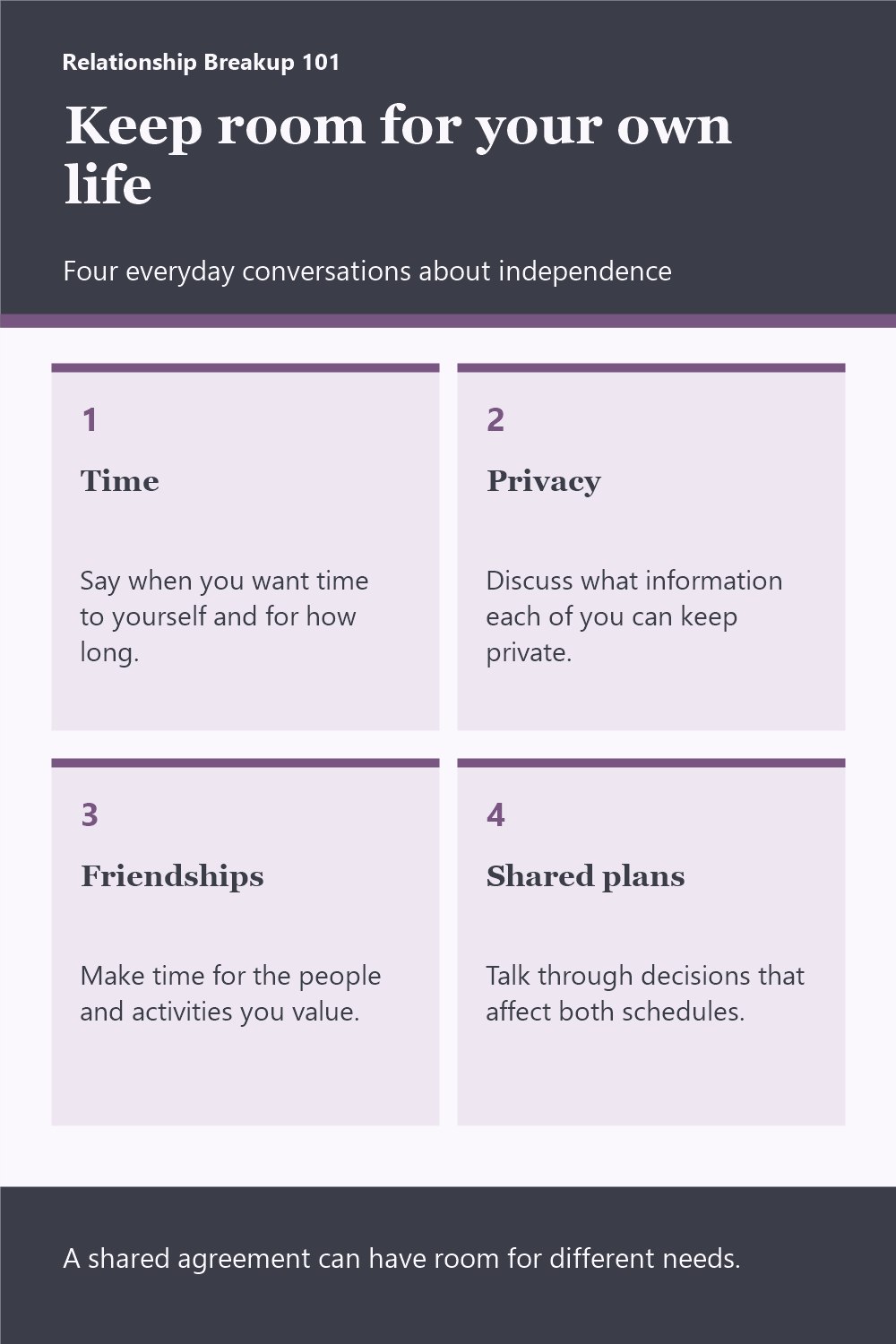
Keep room for your own life Four everyday conversations about independence
- Time Say when you want time to yourself and for how long.
- Privacy Discuss what information each of you can keep private.
- Friendships Make time for the people and activities you value.
- Shared plans Talk through decisions that affect both schedules.
A shared agreement can have room for different needs.