

Chemistry can make you want to know someone better. Compatibility becomes clearer when you see how your needs, values and everyday decisions fit together. You can enjoy the same music and still want very different lives.
A list can help you organise your thoughts, but it cannot certify a perfect match. Use it to begin a conversation about two real people, including the ways each of you can adapt and the things neither of you wants to give up.
On this page

Separate essentials from preferences
Write three short lists: “I need,” “I would enjoy,” and “I can be flexible about.” Respect for your boundaries might be a need; sharing a favourite hobby might be a preference. Keep the distinction clear so attractive extras do not crowd out something essential.
Describe behaviour rather than a vague label. Instead of “stable,” you might write, “We can discuss bills and keep agreements about shared expenses.” Instead of “kind,” ask how each person responds when the other is tired, disappointed or says no.
Talk about the life you each want
Choose one topic at a time: whether to have children, where to live, exclusivity, marriage, work priorities, faith, or the place of extended family. Ask, “What would this look like in your everyday life?” rather than assuming that the same label means the same thing.
Some differences are workable through arrangements both people freely accept. Others involve mutually exclusive goals. If one person wants children and the other does not, do not build a plan around the hope that someone will eventually change their mind.
Notice how daily routines fit
Discuss time together and alone, household tasks, social plans, sleep routines and spending. You do not have to share every habit. You do need a way to handle the effects your choices have on each other.
Make the discussion concrete: “I need quiet after work; could we catch up after dinner?” or “I would like us to agree before inviting overnight guests.” Try an arrangement, then ask whether it actually works for both people rather than assuming silence means agreement.
Look at how you handle a difference
A useful question is whether you can raise a concern without being mocked, punished or frightened. Can each person listen, explain their view and accept responsibility for their own actions? Does an apology lead to a practical change?
You may need a pause before continuing a difficult discussion. Agree when to return to it, where possible, rather than using the pause to make the other person chase a response. The Mental Health Foundation’s relationship guidance offers further ideas on boundaries, listening and reflection.
Review your list against experience
For each important need, note a real example, a question you have not asked, and a concern you want to understand. Keep an unanswered question separate from a conclusion about your partner’s motives.
Revisit your notes after a conversation or a meaningful period of ordinary life. This is not a secret scorecard to use against someone. It is a way to notice whether the relationship being offered matches what you each say you want.
Choose one next conversation
Circle one issue that would make the biggest difference. Try: “We seem to want different amounts of time together. Could we talk about what would feel manageable to each of us?” State your own need and invite an honest answer.
You can choose to keep learning about each other, make a specific agreement or acknowledge a significant mismatch. Compatibility does not mean never compromising; it means that the relationship has room for both people without requiring either to surrender safety, consent or an essential life choice.
Walk through a plan that could actually happen
If you value quiet mornings and they value frequent family visits, talk through a typical weekend. How would you both make room for the people and routines you want? Notice whether each person can describe a preference freely.
Choose one essential question you still need to talk about and one area where you’re flexible. Review what you learn through real plans as well as conversations.
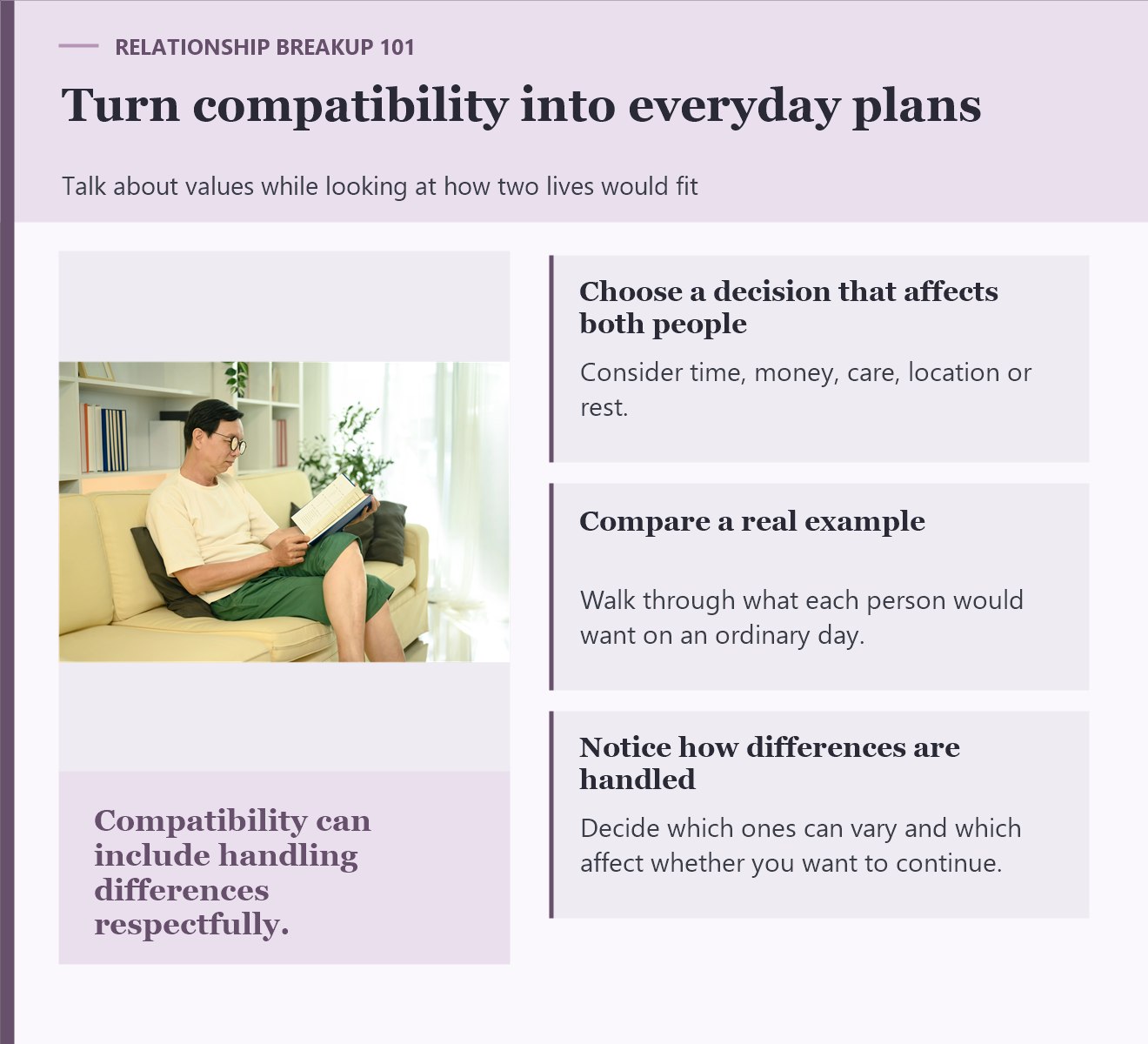
Read the infographic in text
Turn compatibility into everyday plans
Talk about values while looking at how two lives would fit
- Choose a decision that affects both people Consider time, money, care, location or rest.
- Compare a real example Walk through what each person would want on an ordinary day.
- Notice how differences are handled Decide which ones can vary and which affect whether you want to continue.
Compatibility can include handling differences respectfully.