

When care starts to feel like an obligation you cannot refuse, look at specific interactions. The word “codependent” can mean different things to different people; a checklist cannot establish a diagnosis or tell you what another person intends.
These questions are for reflection, whatever your gender or your partner’s. There is no score to add up. Consider what happens repeatedly, how much choice you have and whether your needs and safety are taken seriously.
On this page
- Can I say no without punishment?
- Do my needs have a place in our decisions?
- Does care go in both directions over time?
- Am I taking responsibility for every feeling?
- Can I keep other supportive connections?
- Is privacy respected?
- Do I have access to practical choices?
- What happens when we disagree?
- How are threats of self-harm handled?
- Can I ask for help without losing control of the decision?
- What is one useful next step?
1. Can I say no without punishment?
Notice the response to an ordinary limit, such as needing rest or declining a plan. Disappointment can be part of a respectful conversation. Threats, humiliation, repeated pressure or retaliation are more concerning. You do not need to find perfect wording before a boundary deserves respect.
2. Do my needs have a place in our decisions?
Think of a recent decision about time, money or home life. Could you express a preference and be heard, even if you did not get your first choice? Look for room to negotiate rather than expecting both people to want identical things.

3. Does care go in both directions over time?
Care does not have to be equal every day. Illness, disability, unemployment or parenting can change what each person can do. The question is whether contributions and limits are discussed with respect, rather than whether dependence itself exists. Needing assistance does not make someone controlling.
4. Am I taking responsibility for every feeling?
You can listen, apologise for harm you caused and offer reasonable help. You cannot guarantee that another person will never feel sad, jealous or disappointed. Consider whether you are repeatedly giving up sleep, work or ordinary choices to manage feelings that also require their own support.
5. Can I keep other supportive connections?
Can you speak to friends, relatives or a support worker without being interrogated or made to feel disloyal? Time and caring responsibilities may limit social plans, but those constraints can be discussed. Isolation enforced through threats or monitoring deserves particular attention.
6. Is privacy respected?
Look at actual agreements about phones, passwords, messages and location sharing. Voluntarily sharing something once does not remove your right to reconsider. Demands for constant access or secret monitoring are different from a direct conversation about a specific concern or broken agreement.
7. Do I have access to practical choices?
Consider money, transport, documents, medication and essential care. Shared resources or support needs can make planning complicated. If someone withholds essentials or uses dependence to restrict you, ask an appropriate support service about your options. Difficulty leaving is not evidence that you agree to mistreatment.
8. What happens when we disagree?
Can either person pause a conversation and return to it without being followed, cornered or threatened? Differences do not need to become a contest over who is more independent. If you are afraid of the response, prioritise support and safety rather than testing a new boundary alone.
9. How are threats of self-harm handled?
Take statements about suicide or self-harm seriously, including during a breakup. Do not try to judge sincerity from an argument or carry the responsibility alone. NIMH lists warning signs and U.S. crisis support, including call or text 988. In immediate danger, contact local emergency services. Staying in a relationship is not a substitute for crisis care.
10. Can I ask for help without losing control of the decision?
A trusted person or qualified counsellor can help you sort through events and practical needs. Tell them whether you want support deciding, setting a limit or leaving. You do not have to promise reconciliation as a condition of seeking help. Where abuse is involved, consider individual specialist support first.
11. What is one useful next step?
Choose a specific action that fits what you noticed: arrange a private conversation, ask about practical assistance, speak with a trusted person or contact a specialist service. You can also decide that the relationship is no longer right for you. Avoid setting a confrontation as a test of whether the problem is serious.
The NHS guidance on relationships and mental wellbeing offers further ideas about boundaries, listening and support. If you are worried about control or retaliation, the related guide below focuses on safety and concrete patterns.
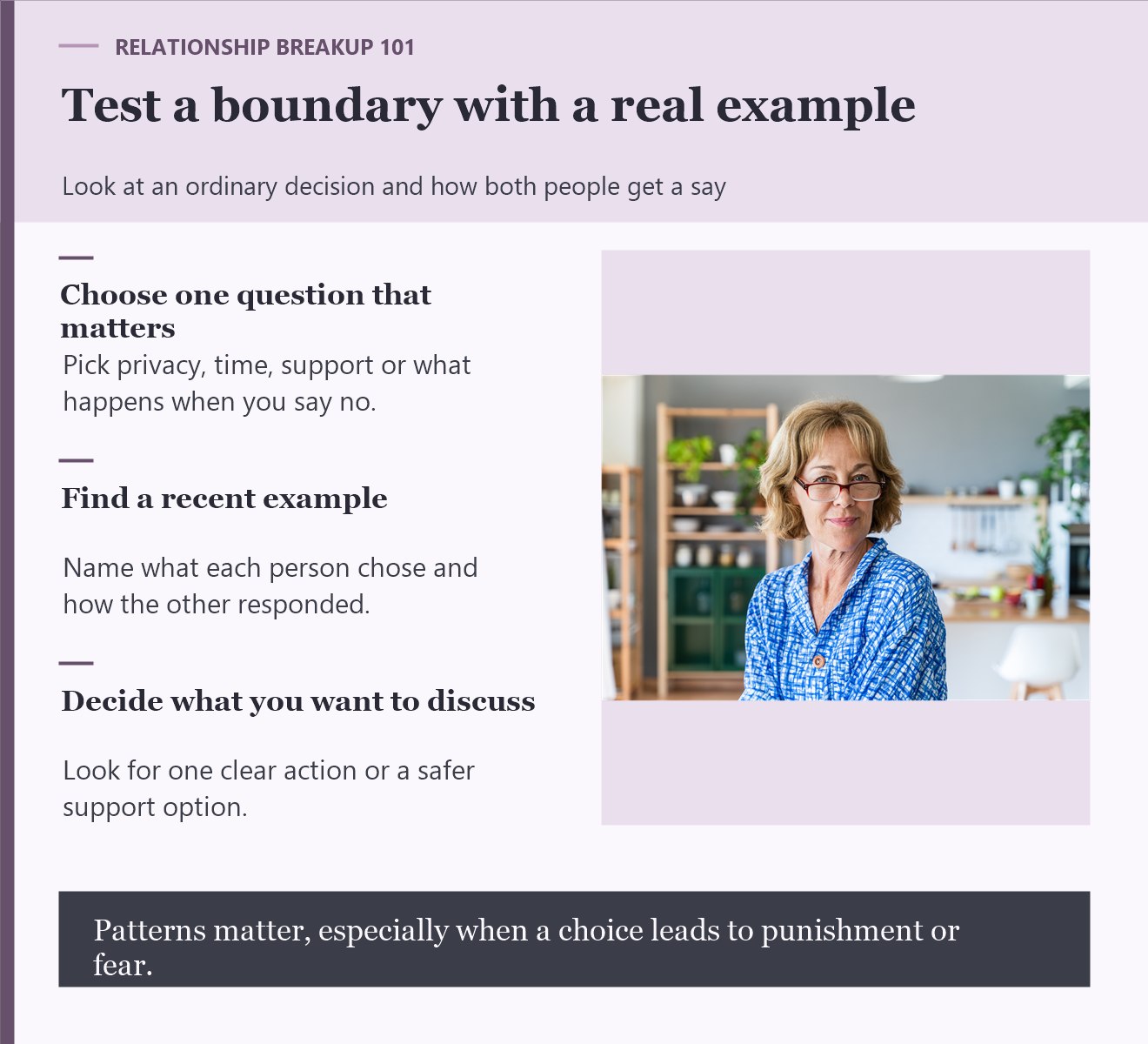
Try one of the questions against a real event
If you are asking whether you can say no, think of the last time you declined a plan. Did they listen, offer another option or keep pressing after your answer? Consider whether the response was unusual or happens often.
If it feels safe, discuss one thing that would help you make ordinary choices. If you fear retaliation or monitoring, consider confidential support before raising it directly.
Read the infographic in text
Test a boundary with a real example
Look at an ordinary decision and how both people get a say
- Choose one question that matters Pick privacy, time, support or what happens when you say no.
- Find a recent example Name what each person chose and how the other responded.
- Decide what you want to discuss Look for one clear action or a safer support option.
Patterns matter, especially when a choice leads to punishment or fear.