

No contact after a breakup can create space from repeated arguments, mixed signals or the urge to seek comfort from an ex. It is a personal boundary, not a guaranteed recovery method or a technique for making someone return.
Some responsibilities remain after a relationship ends. Parenting, work, shared bills and legal arrangements may require limited communication. Define those exceptions clearly so a necessary message does not reopen unlimited personal access.
Give each exception a clear purpose
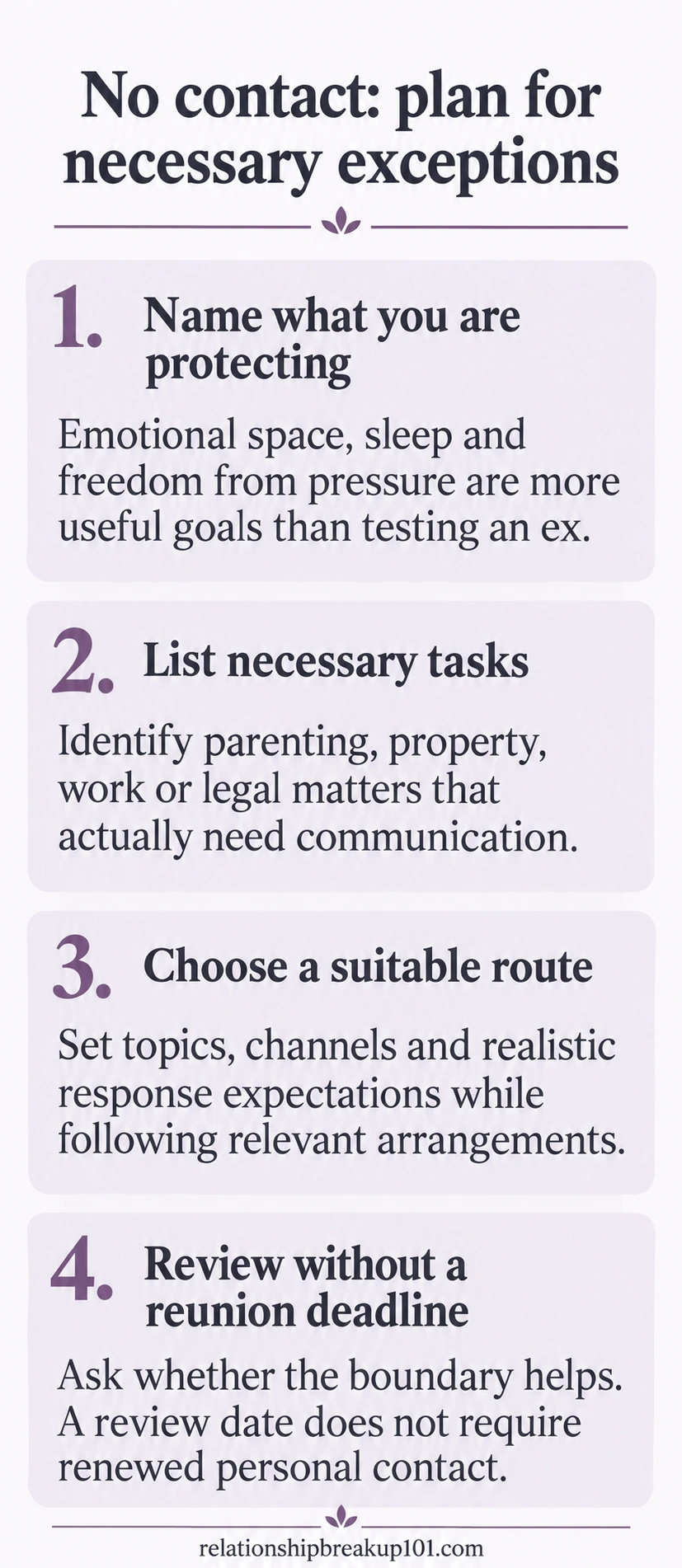
Read the guide as text
- Name what you are protecting. Emotional space, sleep and freedom from pressure are more useful goals than testing an ex.
- List necessary tasks. Identify parenting, property, work or legal matters that actually need communication.
- Choose a suitable route. Set topics, channels and realistic response expectations while following relevant arrangements.
- Review without a reunion deadline. Ask whether the boundary helps. A review date does not require renewed personal contact.
Name Your Boundaries
Ask what's going on when you communicate. Does it leave you feeling more clear, or do the conversations end up in arguments or promises that can't be kept? Are the messages interfering with your daily responsibilities?
You might say something like, "I need room to deal with this change without talking about getting back together every evening." This allows you to look at the boundary and see if it's helping.
The end of a relationship can be experienced as a significant loss. Difficult feelings can be part of adjustment, and support may be useful when distress is persistent or affects daily functioning. No contact doesn’t take away the need for friends, routines, practical help, or professional care where appropriate. It creates space; you still need ways to live within that space.
Defining Contact
When you create a no-contact plan, you have to decide if it includes things like calls, texting, emails, social media, checking profiles, asking friends for updates, attending events that will cause you to run into your ex or other behaviors.
These are behaviors that affect you differently. You might decide you don't want to have a direct conversation but continue talking through email. You might ignore social media feeds without blocking the account that's needed for a shared task. There's no requirement to pick every possible restriction all at once.
You also have to decide what the boundaries don't cover. It shouldn't require friends to monitor your ex or your kids to carry messages for you. It shouldn't be a secret test to see if the person notices that you're not talking to them.
Write out your plan so you can understand it, such as: "For right now, I'm going to only use email and won't talk about the relationship." Setting a clear definition is easier to follow than a promise to be strong when an unexpected notification shows up.
Saying a Brief Statement
In a regular, safe breakup, a brief statement can help clear up confusion. You might say something like, "I need space and won't have personal conversations with you for now. Only email me if you need to pick up your belongings." You don't have to send repeated explanations each time they challenge your boundary. A boundary can be clear without debating it.
If the relationship is abusive or you’re afraid of retaliation, don’t just think that a final message or in-person conversation is safe. Love is respect explains why ending an unhealthy or abusive relationship can require different planning. A professional might be able to help you consider if you should communicate, what channel to use, and what risks a change could create. You do not owe an announcement that increases danger. The goal is a workable boundary, not performing the most polite version of a breakup at any cost.
Parenting Needs a Separate Role
If you have children with this person, no contact can work alongside parenting communication. The details should depend on safety, legal arrangements, and the needs of the child. Don't look at every rule as permission to ignore communication or change parenting orders on your own. When needed, keep the messages focused on the child, use the right communication channel, and know the difference between urgent matters and updates. Children shouldn't be the communication system between two parents.
Justice Canada offers guidance on electronic parenting communication, including clarity and the limits of text-based exchanges. Legal requirements differ by location, so obtain local advice when needed.
If communicating with your ex is unsafe, ask about the right kind of structure or professional arrangements. A third-party app doesn't automatically work. The right arrangement needs to fit your situation.
Keeping Practical Responsibilities Separate from Personal Feelings
Even after a relationship ends, there might still be things you and your ex need to take care of together. Maybe you have to end a lease, divide belongings, pay a shared bill, or figure out arrangements for a pet. Instead of allowing these responsibilities to turn into more arguments, try making a list of what still needs to be done and deciding how much communication each task actually requires.
For example, if your ex sends you a message about a utility bill, that doesn't mean you have to start talking about why the relationship ended or everything that went wrong. You can answer the question about the bill without feeling like you have to explain your feelings or get involved in another emotional conversation.

Sometimes keeping your responses short and simple can make things easier. You might say, "I can pick up the boxes on Saturday at ten. Just let me know where they'll be." This gives the other person the information they need without bringing up past disagreements or creating another opportunity to argue.
But if you're dealing with disagreements about property, shared finances, or legal responsibilities, it's important to get advice from an appropriate professional. Having a friend pass messages between you might help with simple arrangements, but it doesn't replace legal guidance. Informal agreements also don't always change what you're legally responsible for.
It's also a good idea to keep records of important arrangements when it's appropriate and legal to do so. But remember that the purpose is to keep track of practical information, not to collect evidence about every mistake your ex makes.
The important thing is handling the responsibilities that still connect you without allowing every conversation to become another argument about the relationship. You can take care of necessary matters while still maintaining your personal boundaries.
Set Boundaries When You Still See Your Ex
Sometimes ending a relationship doesn't mean you'll never see your ex again. You might work at the same place, attend the same church, have mutual friends, belong to the same social group, or live in a small community where running into each other is difficult to avoid.
But just because you might see each other occasionally doesn't mean you have to give up the boundaries you've set. It's okay to decide ahead of time what kind of communication you're comfortable with and how you'll handle situations where you happen to be in the same place.
If you work together, you might decide to keep conversations focused on work-related responsibilities. You can still be polite and professional without discussing your past relationship during meetings or feeling obligated to respond to personal messages after work.
If your ex begins harassing you, making threats, or interfering with your ability to do your job, it's important to seek appropriate support. Depending on the situation, that might involve speaking with someone in your workplace or getting help from a professional who understands harassment or relationship abuse. You don't have to share every private detail of your relationship with everyone around you to ask for help.
It can also help to think ahead when attending social gatherings where your ex might be present. Maybe you'd feel more comfortable going with a trusted friend, driving yourself, or making plans to leave early if you need to. Having a plan can make these situations feel less stressful.
Remember that you shouldn't have to give up every activity, friendship, or community space you enjoy just because your relationship ended. You still have the right to participate in things that matter to you while maintaining appropriate boundaries.
The goal is to find ways to handle unavoidable interactions without feeling pressured to reconnect or revisit the past. You can be respectful when necessary while still protecting your personal space, independence, and emotional well-being.
When Replies Are Necessary
A limited-contact plan can work better when the understanding is clear. Think about what topics need to be discussed, how often you'll look at messages, and what happens in a real emergency.
Don't promise a response time that you can't guarantee. Work, caregiving, disability, and access to devices can affect how available you are. Legal or parenting obligations can also change the plan.
You might say something like, "I'll check this email each evening for these matters. If there's an urgent issue that affects the property, then use the phone number that we agreed on." This is not a universal answer, but this is just an example of how you could handle the contact.
Don't use response delays to punish the other person or to create stress. The purpose is to protect your attention while still meeting your responsibilities. You can stay brief and reliable without being emotionally available for every concern your ex-partner wants to talk about.
When You Want to Reach Out
When something comes up, like a hard day, a happy event, an anniversary, or a familiar song, you might have an urge to contact your ex. This doesn't automatically mean that the breakup was wrong or that the boundary needs to end. Before you reach out, find out what you want from the message, such as comfort, an apology, a reunion, or relief from uncertainty, and then think of another way to meet these needs.
You can write a message without sending it, call a friend, make a note for the next exchange, or wait until after you've slept. Taking time to pause can help you decide, rather than being a rule that means you're suppressing all your feelings.
If you do send them a message, look at what happened without deciding that the whole plan was ruined. One contact is information about a hard moment. You can change the boundary, restate it, or get new support.
Decide Which Messages Deserve a Response
After a breakup, getting an unexpected message from your ex can bring up different emotions. Sometimes the message might be about something practical, while other times it could be affectionate, angry, apologetic, or an attempt to manipulate your feelings. But just because your phone lights up doesn't mean you have to respond right away or even respond at all.
Before answering, think about what the message is actually saying and whether it's something you need to discuss. If your ex asks about a shared responsibility, you can give a simple answer without getting into personal matters. But if they're sending emotional messages or trying to reopen conversations about the relationship, you might decide not to respond or briefly remind them of your boundaries if it's safe.
Remember that an apology doesn't mean you have to agree to meet or start talking again. You also shouldn't feel responsible for responding to every emotional message simply because your ex is upset.
But if a message includes threats, signs of stalking, or statements about self-harm, take those concerns seriously. Depending on the situation, you might need help from emergency services, crisis support, or another qualified professional.
You shouldn't feel like you're the only person responsible for handling your ex's emotional crisis or that you have to return to the relationship because they've threatened to hurt themselves. You can maintain your boundaries while involving appropriate help.
Don't promise to keep serious safety concerns a secret. If someone appears to be in immediate danger, getting help is more important than trying to handle everything through personal messages.
The important thing is recognizing which conversations are necessary, which ones you can decline, and when a situation requires professional support.
Don't Rush Yourself into Reconnecting
When you're going through a breakup, you might come across advice telling you to wait a certain number of days before contacting your ex or that you should feel better after a specific amount of time. But every relationship is different, and there's no timeline that works for everyone.
Sometimes setting a date to think about how things are going can be helpful. But that doesn't mean you have to reconnect or decide whether to get back together when that date arrives. Instead, think about whether your boundaries are helping, whether shared responsibilities are being handled, and whether you genuinely want anything to change.
You might decide to go a month without personal contact. When that month ends, you could realize that you need more time or that limiting communication has been helpful. You don't have to start talking again simply because the month is over.
You can continue your boundaries, make them stricter, allow certain necessary conversations, or seek professional advice about what arrangement makes sense for your situation. Your ex might have opinions about what they want, but that doesn't mean they're entitled to your time or attention.
It's also important not to treat reconnecting as a reward for respecting your boundaries. For example, promising to consider getting back together if your ex leaves you alone for thirty days can create expectations you might not want to fulfill.
Instead, be honest about what you've decided and what you're still unsure about. You can appreciate someone respecting your boundaries without promising another chance at the relationship.
The important thing is remembering that moving forward happens at your own pace. You don't have to follow someone else's timeline, rush into reconnecting, or make promises about the future. Your boundaries should help you protect your peace and make decisions that feel right for your life.
Taking Action
For an illustrative example, imagine two separated partners who still need contact about a shared rental account. One wants a break from having personal conversations because each conversation is about getting back together.
She might choose an email thread for the account, check it when she can, and respond only when there are questions about the account. A property professional can handle disputed issues when appropriate.
If the other partner adds a personal paragraph, she can answer the account questions without replying to the invitation. She doesn't have to argue about whether the email is breaking no contact.
This example shows why the purpose matters more than what you label it. One partner is creating emotional space and doing their responsibilities. A good exception has a task that's understood and an ending, and it doesn't reopen unlimited access.
Looking at Support and Boundaries
If life is hard, no matter how much you've reduced contact, ask what else is missing. You might need help with things like finances, housing, isolation, parenting, or distress. Even if you set a communication boundary, it doesn't solve every problem from a breakup.
Think about speaking to a mental health professional if the symptoms get worse, continue, or make it hard for you to function. Get urgent help if there's immediate danger or thoughts of self-harm. Practical support from trusted people can make a big difference in your life.
You can ask someone for a specific kind of help, such as asking them to come over in the evening, help you with a task, or look at an unsent message in the morning. Don't make a friend responsible for policing all of your behavior.
The purpose is to make your life better around your boundaries. Better routines and support can make it easier to pick up contact purposefully instead of using it only when you want to respond to loneliness or stress.
Picking a Plan That is Right for You
A good no-contact or limited-contact plan answers questions such as: What is the purpose, what communication is needed, how will the communication happen, and when will you look at the arrangement again?
If you need to add safety and professional advice, do it. Don't ignore legal duties, use the children as bait, or expose yourself to danger to follow a certain arrangement.
You can need distance and still be responsible. You can complete a task that you share without allowing emotional closeness. You can decide what worked before and what in the arrangement needs a change.
The best kind of boundary is one that supports your choices and your stability. Let it be clear enough to use, flexible enough to be responsible, and firm enough to protect the space around you. Recovery doesn't mean that you have perfect rules, but it requires care for real-life situations.
Plan necessary contact after a breakup
Choose the reason contact may be needed. Keep any existing court orders and specialist safety guidance in view.
A contact restriction or safety concern overrides ordinary communication advice. Get appropriate advice before changing arrangements.
Use the questions and examples in the article above; the draft builder needs JavaScript.
15 questions readers ask
1. What does no contact mean?
It is a chosen limit on communication with an ex. Define what it includes rather than assuming everyone uses the phrase the same way.
2. Will no contact make my ex return?
There is no guarantee. Use boundaries to support your choices and stability rather than to control another person's response.
3. Is there a required number of days?
No universal number fits every situation. You can choose a review point without promising contact or reconciliation then.
4. Can I use limited contact instead?
Yes. Necessary practical communication can be separated from personal conversations when that arrangement is appropriate and safe.
5. What if we share children?
Follow relevant parenting and legal arrangements and use an appropriate communication route. Children should not become messengers or be used to enforce a boundary.
6. What if we work together?
Keep necessary contact focused on work. Seek appropriate support if personal messages, harassment or threats interfere with safety or your job.
7. Should I block every account?
Consider necessary responsibilities and safety before changing access. Blocking may be useful, but it is not a universal rule.
8. Do I owe a final explanation?
In a safe situation, a brief statement may clarify the boundary. You do not owe an announcement or meeting that increases danger.
9. What if my ex asks about a bill?
Answer the practical question through the agreed route if needed. That does not require discussing the former relationship.
10. Should I reply to an apology?
An apology does not create an obligation to meet, reconcile or resume personal contact. Consider your boundary and safety.
11. What if I send a message after deciding not to?
One contact does not erase your choices. Look at the trigger, adjust the plan if useful and seek support without treating it as a failure.
12. Can friends pass messages?
An appropriate adult may help with a limited task, but should not be recruited to monitor an ex. Informal arrangements do not replace legal guidance.
13. What if they threaten self-harm?
Take the threat seriously and involve appropriate crisis or emergency help. You are not the sole crisis responder and do not have to return to the relationship.
14. What if unwanted contact becomes stalking?
Seek specialist support and assess safety rather than relying on ordinary breakup rules. Keep records when appropriate and safe.
15. How do I review whether the boundary works?
Ask whether needed tasks are handled, pressure has reduced and your daily life has adequate support. Revise the plan around real needs.