

A breakup letter or message can give you space to choose clear words. It can also be appropriate when a face-to-face conversation is not workable or safe. The purpose is to communicate your decision and any necessary next steps, rather than to create a perfect explanation that makes the breakup painless.
These steps are for a decision you have already made. If you are still unsure, write privately to clarify your thoughts before sending a final message. You can decide to end a relationship without getting agreement from your partner, while still considering shared responsibilities.
On this page
1. Decide whether writing is a suitable and safer format
Consider what usually happens when you discuss difficult subjects. Does a conversation stay respectful, or do you become overwhelmed, pressured or afraid? A call, letter or supported arrangement may be more suitable than a private meeting. Written messages can be saved or forwarded, so consider what information you include.
If there has been abuse, stalking, monitoring or intimidation, seek specialist advice about the timing and method before sending plans or announcing a location. The National Domestic Violence Hotline’s safety-planning guidance is a useful starting point. Consider a safer device if yours may be monitored.

2. Write the decision early
Avoid several paragraphs of praise or shared memories before the main point. A direct opening might be: “I have thought about our relationship, and I have decided to end it.” Use a final statement only if that is what you mean.
Calling it a break or saying “for now” can imply a future reunion. If you do want a temporary pause, that requires a different conversation about what the pause means. Do not offer uncertainty merely to make a final decision sound gentler.
3. Give a brief reason that is true for you
You might explain that the relationship no longer fits what you want, that an important need remains unmet, or that a recurring pattern has affected your decision. Choose the level of detail that is appropriate and safe. You do not need to provide a catalogue of every disagreement.
Avoid invented reasons, insults or a diagnosis of your partner. “I do not want to continue this relationship” is clearer than a list of changes you do not actually want them to attempt. You can acknowledge good aspects without suggesting they cancel your decision.
4. Keep practical arrangements specific and separate
If there are belongings, bills, housing or caring responsibilities to address, identify the immediate task and a workable way to communicate about it. For example: “Please email me about a time to collect your books.” Do not include a meeting place or schedule if that could create a risk.
A letter cannot settle every shared obligation. Get appropriate independent advice about legal, financial or parenting arrangements in your location where needed. Keep children out of the role of messenger, and avoid making commitments you have not considered.
5. State the contact you can manage
If you want a pause from personal contact, say so clearly. If some communication must continue, describe the subjects and channel where possible. “I will respond to emails about the tenancy” is more specific than saying you will always be available.
Do not promise friendship to soften the news if you do not want it or cannot offer it. Both people get to decide whether later friendship is suitable. If unwanted contact or threats continue, ask an appropriate support service about your options.
6. Read it for clarity, tone and unintended promises
Check that the decision is easy to find, the reason is accurate and the practical request can be understood. Remove sarcasm, repeated accusations and phrases that accidentally invite negotiation when your decision is final. Keep any apology specific to harm you actually caused.
If it is safe and useful, ask someone you trust to check whether the letter says what you mean. Their role is to help with clarity, not to decide whether you are allowed to leave. Keep sensitive drafts and plans somewhere appropriate for your circumstances.
7. Plan what happens after you send it
Choose a time and a next step that are workable for you. Arrange support, somewhere to be and essential practical help if needed. A clear letter can still bring sadness, questions or disagreement; it cannot guarantee a calm response or immediate closure.
Decide which practical questions you are willing to answer and how you will handle repeated requests to reconsider. You can end an exchange that becomes threatening or overwhelming. Use the examples below as starting points, and keep only wording that is true and suitable for you.
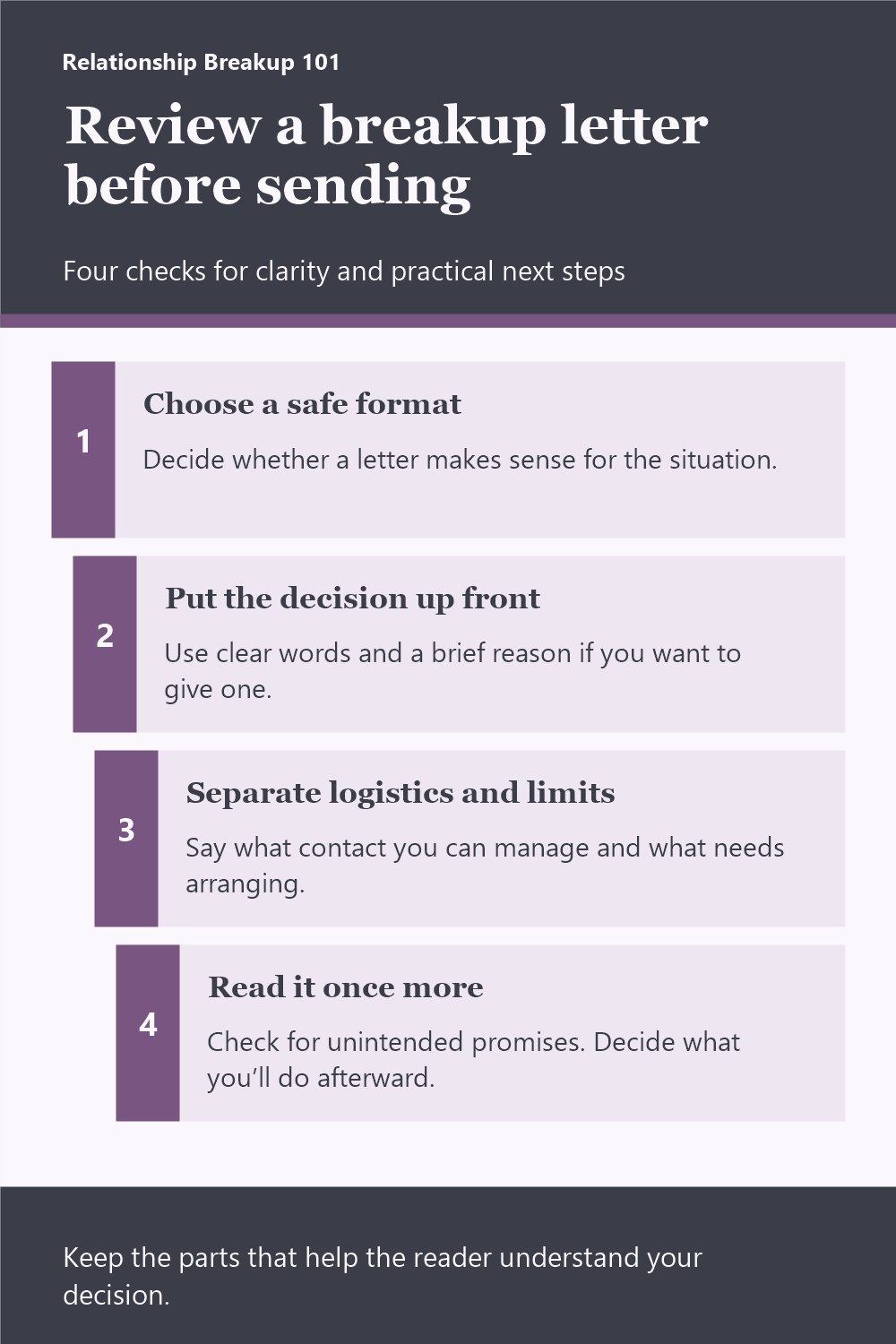
Read the infographic in text
Review a breakup letter before sending
- Choose a safe format Decide whether a letter makes sense for the situation.
- Put the decision up front Use clear words and a brief reason if you want to give one.
- Separate logistics and limits Say what contact you can manage and what needs arranging.
- Read it once more Check for unintended promises. Decide what you’ll do afterward.
Keep the parts that help the reader understand your decision.