

When a relationship leaves you afraid to speak, make choices or keep in touch with other people, it can be difficult to describe what is happening. Affection, apologies or periods of calm may sit alongside behaviour that hurts or restricts you.
The seven patterns below offer words for common concerns. They are not a diagnostic quiz, and you do not need to recognise all seven before asking for support. One serious incident can also be enough to need help.
On this page
Notice the effect on your freedom
Emotional abuse can involve non-physical behaviour used to intimidate, isolate or control a partner. The National Domestic Violence Hotline describes emotional abuse and examples of controlling behaviour. You do not need a visible injury to take your concerns seriously.
Consider what happens when you disagree or make an ordinary choice. Can you say no, see someone you trust or raise a concern without fearing retaliation? Describe specific actions and their effects rather than trying to prove what your partner intended.
Seven patterns to take seriously
- Fear around disagreement. You keep changing what you say or do because you are afraid of the reaction.
- Repeated humiliation. Insults, ridicule or belittling are used to undermine you, including in front of others.
- Isolation. Your contact with friends, family or other support is restricted or punished.
- Monitoring. Someone reads private messages, tracks you or demands continual reports of your whereabouts.
- Accusations used to control. Repeated claims that you are disloyal become a reason to restrict ordinary choices.
- Threats against you or others. Harm is threatened to make you comply or prevent you from leaving.
- Self-harm threats tied to your choices. You are told that saying no or ending the relationship will cause them to hurt themselves.
These examples are not a complete list. You can ask for help without deciding which label fits. A supportive conversation can begin with one incident: “This happened, and now I’m afraid to make plans without permission.”

Choose a manageable first step
If possible, speak privately with a trusted person or a domestic-abuse advocate using a safer device if yours may be monitored. Explain what has happened and what you are worried about. You do not have to arrive with a complete plan or a decision to leave.
If keeping a record is safe, note dates and concrete incidents rather than conclusions about a personality. Think about where information could be stored without increasing risk. An advocate can help you consider documentation, contact and everyday practical needs.
You do not have to confront your partner or disclose that you are seeking help. Making someone understand your concern is not a condition of deserving support.
Get help with threats of harm
Take threats of suicide or self-harm seriously. Seek emergency help for immediate danger or contact an appropriate crisis service for guidance. Do not assume a threat is harmless, and do not try to manage the risk entirely on your own.
You can involve appropriate help without promising to stay, giving up a boundary or agreeing to a private meeting. The Hotline offers guidance on responding when a partner threatens suicide. Threats against you, children, other people or pets also deserve urgent attention and individual safety advice.
Find support for what comes next
There is no single exit rule that fits everyone. Housing, children, finances, disability, immigration concerns or monitoring can affect what is possible. A specialist can help you consider options while you are in the relationship, preparing to leave or already separated.
The Hotline’s personal safety-planning guidance is a starting point; seek a suitable local service for support where you live. Contact local emergency services if there is immediate danger and it is safe to do so.
You do not have to minimise what happened because someone apologised or because other moments felt loving. Start with one source of support and one concern you want help thinking through. The responsibility for stopping abusive behaviour belongs to the person doing it.
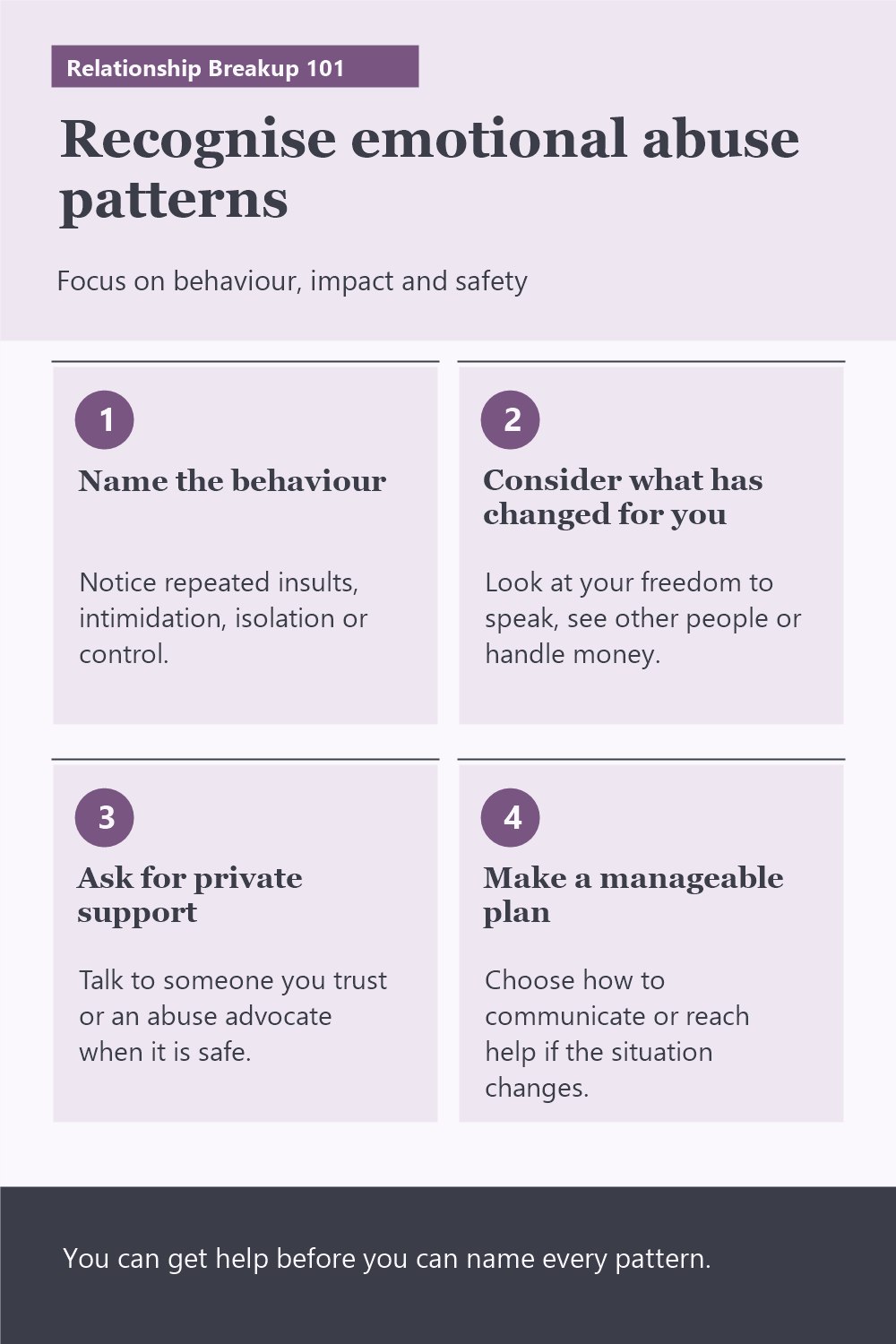
Read the infographic in text
Recognise emotional abuse patterns
Focus on behaviour, impact and safety
- Name the behaviour Notice repeated insults, intimidation, isolation or control.
- Consider what has changed for you Look at your freedom to speak, see other people or handle money.
- Ask for private support Talk to someone you trust or an abuse advocate when it is safe.
- Make a manageable plan Choose how to communicate or reach help if the situation changes.
You can get help before you can name every pattern.