

Today we have a guest blog from Marriage and Family Therapist (MFT) and relationship expert who goes by the name Perry (online, at least). Perry is giving her take on when you might consider breaking up with your boyfriend).
Different plans can raise a difficult question: can you build a life together that both of you freely want? Start with the actual choices ahead, rather than assuming that every disagreement means you should leave or that love requires one person to give up their future.
These questions can help you describe the difference and choose a next step. They are prompts for reflection, not a score or a test that decides whether your boyfriend is right for you.
On this page
- Say what you each want without assuming the answer
- Separate flexible arrangements from important needs
- Work through the practical version of a plan
- Look at everyday care as well as early excitement
- Explore what interest in another future means to you
- Choose a clear next step rather than an indefinite promise
1. Say what you each want without assuming the answer
Be specific about the issue: where to live, whether to have children, the kind of commitment you want, work, study or time with family. A general hope that you will eventually want the same things can hide a decision that needs a direct conversation.
Try asking, “What would you choose if neither of us were trying to give the other person the answer they want?” Listen to the answer as it stands. Wanting marriage, remaining unmarried or choosing a life without children does not make either person’s preference automatically more important.

2. Separate flexible arrangements from important needs
Compromise does not always mean that nobody gets what they want. You may find a workable arrangement about travel, daily routines or how to share responsibilities. Describe what each person would gain, give up and need in order to agree freely.
Some choices involve a difference that cannot be solved by splitting the distance. If one person wants children and the other does not, for example, avoid treating agreement under pressure as a settled solution. You can take the difference seriously without blaming either person for having it.
3. Work through the practical version of a plan
If the issue is moving, work or study, discuss an actual arrangement rather than only saying that things will work out. Consider costs, travel, housing, time together and responsibilities that would remain. Check what is known and what still needs information.
A trial arrangement may help if both people want it and can review it honestly. It does not guarantee a particular outcome. Avoid committing to a move, a financial obligation or a shared plan mainly because saying no feels disloyal.
4. Look at everyday care as well as early excitement
The intensity of early dating can change. Fewer surprise messages or less time analysing every date does not by itself establish that the relationship has run its course. Consider whether you still want the connection and how you treat each other now.
Can you discuss a need, disagree or decline something without fear? Ordinary care includes respecting a refusal and taking responsibility for agreements. If threats, control or intimidation shape your choices, seek support before trying to resolve the situation through a more persuasive conversation.
5. Explore what interest in another future means to you
Imagining life alone or feeling attracted to another person can prompt reflection, but neither is a complete verdict on your current relationship. Ask what the imagined alternative represents: independence, attention, a different pace of life or a need you have not yet named.
Consider your relationship as it actually is, rather than comparing it with an imagined life without difficulties. Be honest about what you want, and respect the agreements you have made while deciding whether you want to continue them.
6. Choose a clear next step rather than an indefinite promise
You might arrange a conversation, get practical information or take time to decide what you are willing to continue. A useful opening is, “I want to talk about where we each hope to live and what the next year would involve.” Keep the discussion focused on the question you need answered.
If you no longer want the relationship, you do not need to prove that your boyfriend is a bad person before ending it. Prepare clear words and any shared arrangements that need attention. You can acknowledge that the decision may hurt while avoiding promises of a reunion you do not mean.
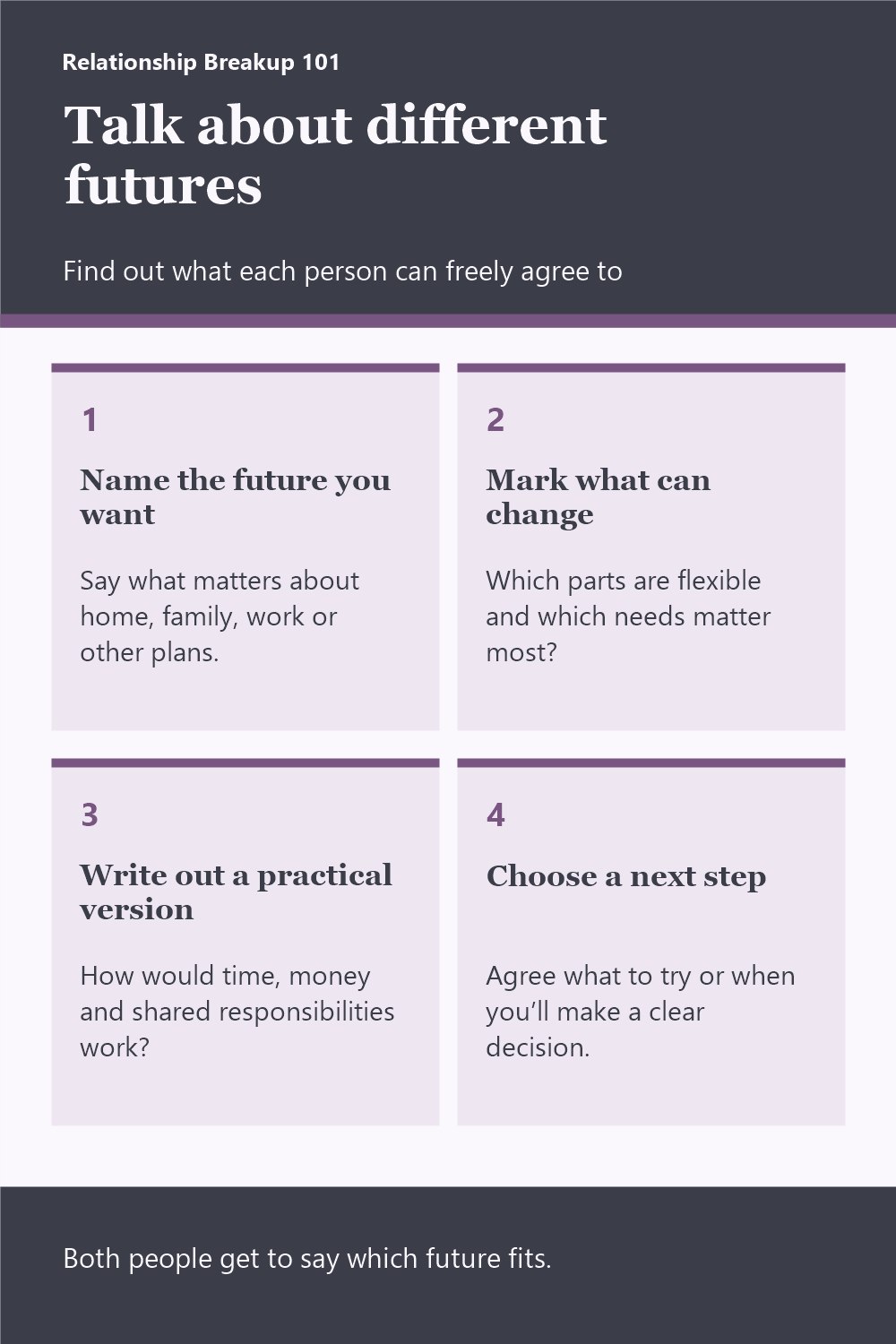
Read the infographic in text
Talk about different futures
- Name the future you want Say what matters about home, family, work or other plans.
- Mark what can change Which parts are flexible and which needs matter most?
- Write out a practical version How would time, money and shared responsibilities work?
- Choose a next step Agree what to try or when you’ll make a clear decision.
Both people get to say which future fits.