

After a breakup, familiar parts of the day can feel unfamiliar. Messages stop, plans change and a quiet evening may bring feelings you did not expect. Finding yourself again can begin with making ordinary life more manageable, while giving yourself room to decide what you want next.
You do not need to become a different person, stop caring about your ex or start dating to show progress. These ten suggestions are choices to adapt to your circumstances. Begin with the one that would help today.
In this guide
- Make room for what you have lost
- Name feelings without following every urge
- Separate reflection from self-blame
- Choose a workable contact boundary
- Handle anger without hurting yourself or others
- Protect your privacy and future choices
- Let ordinary moments count
- Rebuild a routine that belongs to you
- Decide about dating at your own pace
- Ask for the support you need
1. Make room for what you have lost
You may miss the person, the companionship, a shared home or the future you expected. You might also feel relief. An ending can change several parts of life at once, and different losses may become noticeable on different days.
You do not need to prove that the relationship was perfect to feel sad about its end. The NHS guide to grief and loss includes relationship endings and explains that feelings can vary and arrive unexpectedly. There is no required sequence of emotions to complete.
Try naming one thing you miss today. “I miss having someone to eat dinner with” points towards a need you can consider, even when the relationship itself cannot be restored.
2. Name feelings without following every urge
A feeling does not require an immediate action. You can miss your ex without sending a message, feel angry without posting about them or enjoy an afternoon without deciding that you have finished grieving.
When an urge arrives, pause long enough to ask: What am I feeling? What am I hoping this action will do? What might make the next hour easier without creating another problem? You could write a message privately and leave it unsent, call someone you trust or step away from an upsetting feed.
Choose what feels workable. You do not have to journal, cry or talk about the breakup every day to take it seriously.
3. Separate reflection from self-blame
You can learn from a relationship without turning its ending into a verdict on your worth. Try separating three questions: What happened? What was within my control? What would I like to handle differently in the future?
Be specific. “I agreed to plans I did not want” gives you something to practise changing. “I ruin every relationship” is a much broader conclusion than the situation can support. You are also not responsible for another person’s choice to threaten, deceive or hurt you.
If betrayal is part of what you are processing, the guide to trust after cheating discusses accountability and choice. Considering what happened does not obligate you to try the relationship again.
4. Choose a workable contact boundary
Some people find a period without personal contact useful. Others need to communicate about children, housing, belongings, work or shared responsibilities. Choose a boundary around the situation you actually have, rather than treating total silence as a test of recovery.
If it feels safe, make a necessary arrangement clear: “Please use email for the remaining household arrangements. I will check it once each evening. I’m not available to discuss getting back together.” Set a response schedule that fits any genuine responsibilities; avoid promising a schedule you cannot keep.
Muting updates or asking friends not to pass on news may create some breathing room. If contact involves harassment, threats or fear, seek private support about a safer plan. You do not need to announce a boundary if doing so would put you at risk.
5. Handle anger without hurting yourself or others
Anger may be present, absent or mixed with other feelings. You do not have to reach a stage of hatred, and you do not need to become indifferent before you can move forward.
Notice when you are too upset to make a decision you can support later. If it is safe, pause the conversation, leave a draft unsent or ask someone to stay with you while you settle. A walk, a quiet task or a private conversation may suit you better than trying to force a release.
Avoid threats, damage, humiliation or retaliation. If you are afraid you might hurt yourself or someone else, get urgent help from an appropriate local emergency or crisis service.
6. Protect your privacy and future choices
A breakup does not require a public explanation. Decide what you want to share, with whom and for what purpose. You can ask a friend to keep a conversation private or say that you are not ready to discuss details.
Before posting, consider whether the content reveals addresses, private messages, children’s information or details you may later wish you had kept to yourself. You can save evidence you need privately without turning it into a public argument.
Make a short list of practical matters still to resolve, such as belongings or account access. Seek suitable advice where property, money or parenting arrangements are complicated. Avoid making legal or financial decisions solely to get the emotional conversation over with.
7. Let ordinary moments count
You do not have to find a hidden blessing or feel grateful for the breakup. A pleasant moment can simply be pleasant. Enjoying food, laughing with a friend or concentrating on a familiar activity does not erase what happened.
Choose an activity for the experience itself rather than for how it might look to your ex. It can be inexpensive and small: sitting outdoors, listening to music, visiting a library or making a meal you enjoy.
If a reminder brings sadness back, that does not cancel the moment you enjoyed. Both experiences can belong to the same day.
8. Rebuild a routine that belongs to you
Look for the points in your day that became harder after the separation. A quiet evening, an empty weekend or a task your partner used to handle may need a different arrangement.
Choose a modest plan for one of those gaps. For example:
- Keep an easy meal available for an evening when cooking feels difficult.
- Arrange a short call with a friend at a time you used to spend together.
- Ask for help with one unfamiliar household task.
- Put one manageable activity in the calendar, with room to change it.
Adapt the plan to your energy, access needs and responsibilities. The aim is to make daily life more workable, without turning recovery into a self-improvement project.
9. Decide about dating at your own pace
You may want companionship soon, want a long pause or prefer to stay single. None of those choices proves how much the past relationship meant or how successfully you are coping.
If you consider dating, ask what you want to offer and receive now. Can you communicate your availability honestly? Do you want a date, a relationship or simply more social contact? You can change your mind without treating another person as a solution to the breakup.
Friendship with an ex also needs willingness and boundaries from both people. You do not have to promise it now, and you do not need to rule it out forever to take space today.
10. Ask for the support you need
Tell someone what would help rather than hoping they can guess: “Could you listen for ten minutes without giving advice?” or “Could you help me organise the weekend?” Support can include company and practical help as well as conversations about feelings.
The NHS guidance on relationships and wellbeing suggests making time for your own interests, setting limits and speaking with someone you trust. Choose a person who respects your privacy and decisions.
If distress is affecting sleep, eating, work or your ability to manage daily life, consider speaking with a healthcare professional or qualified counsellor. You do not have to wait for a recovery deadline before asking for help. If you cannot stay safe, contact a local emergency or crisis service immediately.
For today, choose one action you can manage and one person or service you could turn to. You can review the rest when you have more space.
Read the infographic in text
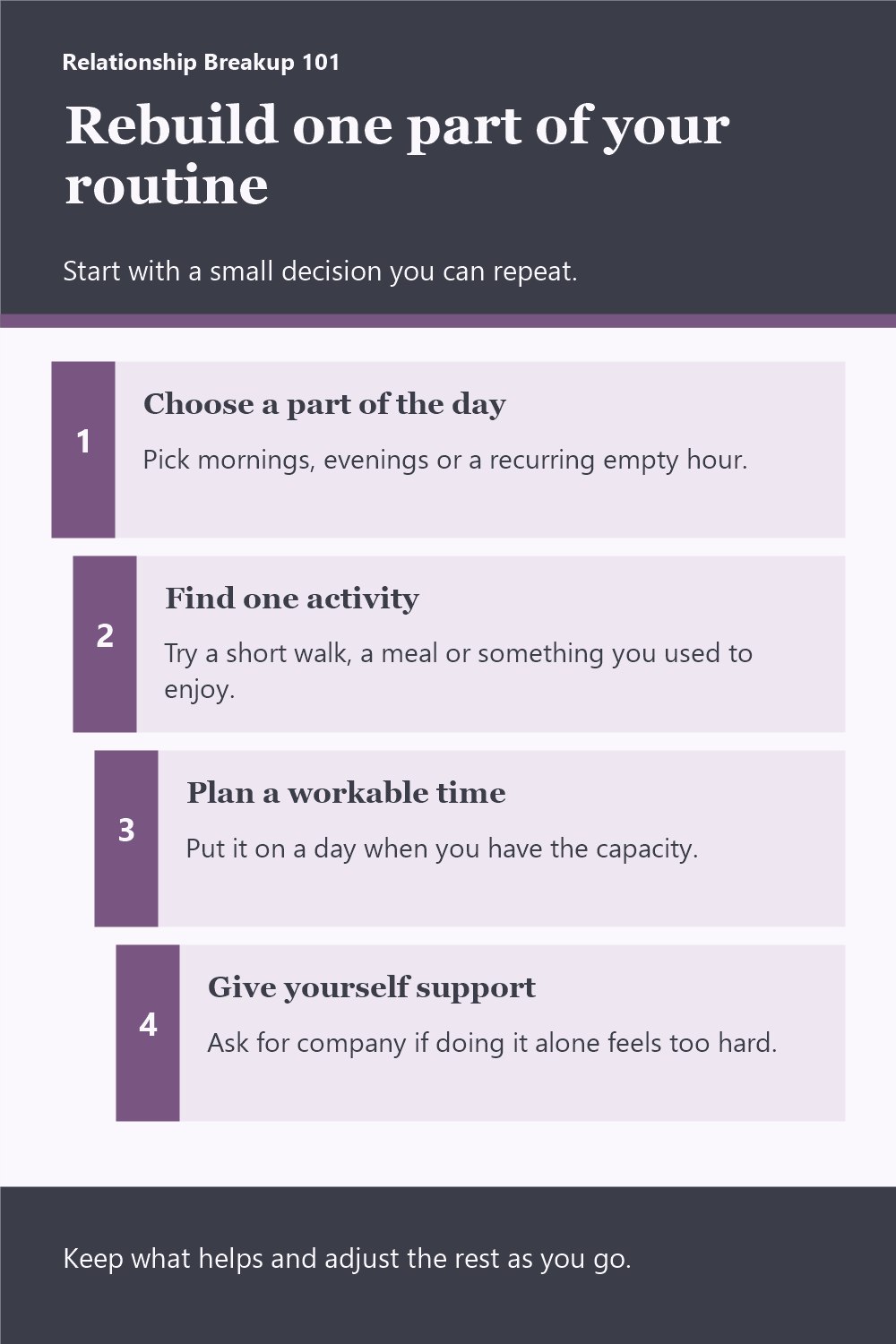
Rebuild one part of your routine Start with a small decision you can repeat.
- Choose a part of the day Pick mornings, evenings or a recurring empty hour.
- Find one activity Try a short walk, a meal or something you used to enjoy.
- Plan a workable time Put it on a day when you have the capacity.
- Give yourself support Ask for company if doing it alone feels too hard.
Keep what helps and adjust the rest as you go.