

After a partner cheats, you may want to trust him again and still feel hurt, angry or unsure. You do not have to put those feelings aside to think carefully about your next step. You can consider repair, take time to decide or choose to leave.
Trust depends on what each person chooses and does over time. Your confidence, forgiveness or willingness to work on the relationship cannot guarantee another person’s behaviour. Begin with your safety, the information you need and the choices you want to keep available.
In this guide
1. Give yourself room to decide
You may need space before discussing the future. If it feels safe to say so, you could explain: “I’m not ready to decide whether to stay. I need some time and clear answers before I can consider that.” You do not need to promise forgiveness in order to have a conversation.
Think about immediate needs separately from the long-term decision. Where can you rest? Who can listen without pressuring you? Which household or care responsibilities need a practical arrangement? You can make a plan for today without agreeing to continue the relationship indefinitely.
If raising the subject could lead to threats, intimidation or punishment, seek private support before planning a joint conversation. Your safety matters more than completing a discussion. Our guide to taking stock of your relationship offers questions about needs, space and choice.
2. Look for responsibility and honest answers
The person who broke an agreement is responsible for that choice. Relationship difficulties can be discussed, but they do not transfer responsibility for deception to the person who was deceived. You do not have to accept an explanation that blames your appearance, availability or emotional response.
Consider what you need to understand before choosing a next step. You may want to clarify what agreement was broken, whether the contact or behaviour is continuing and what your partner is willing to change. You can ask direct questions without requiring every detail to be discussed at once.
Notice the response as well as the words. Can your partner acknowledge the harm, answer without attacking you and accept that your decision may be different from theirs? An apology can begin a conversation; it does not establish that the issue is resolved.
3. Make the next agreements specific
If you both want to explore repair, choose actions you can recognise. “I’ll do better” leaves a lot unclear. An agreement could cover how you will handle changes of plan, what contact with another person will involve or when you will return to a difficult discussion.
Keep the discussion manageable. For example, you might agree to a short check-in at a time that suits you both, with the following agenda:
- What did we agree to do since the last conversation?
- What happened, and what still needs clarification?
- What is one practical change each person is willing to make?
- When will we review whether this is working?
Where work, parenting or other responsibilities make some contact unavoidable, discuss realistic boundaries rather than making promises that cannot be kept. Leave room to say that a proposed arrangement does not work for you. The guide to clear requests and difficult conversations can help you put a concern into words.
4. Keep privacy, consent and boundaries in view
You can ask for honesty and reassurance without secretly accessing accounts, tracking someone or making constant checking the foundation of the relationship. Discuss what each person freely agrees to share and what you will do if the arrangement does not meet your needs.
Love is respect’s guidance on trust after cheating stresses responsibility, follow-through and each person’s continuing right to privacy. It also makes clear that no one can guarantee a partner will never cheat again. You can use the information available to make a choice without claiming certainty about the future.
Boundaries also apply to physical and sexual contact. Staying together, accepting an apology or wanting reassurance does not require you to have sex or offer affection you do not want. If you have sexual-health concerns, speak with a healthcare professional or clinic about appropriate testing and care. The NHS overview of sexual-health clinics explains the kinds of advice and testing these services can provide.
5. Leave room for feelings without a deadline
You may have a calm day followed by another difficult one. A reminder can bring the hurt back, and a practical conversation may still be needed. Try to name the present concern: “I felt unsettled when the plan changed without a message,” gives you something clearer to discuss than a demand that you stop being upset.
Forgiveness, continuing a relationship and rebuilding trust are different decisions. You may be uncertain about one while knowing what you want from another. There is no need to make forgiveness a test of maturity or to describe your understandable questions as paranoia.
You can express hurt and still keep a limit on how conversations happen. Insults, threats, humiliation or retaliatory cheating will not make an agreement clearer. If a discussion is escalating and it is safe to pause, choose another time to return rather than forcing an answer in the moment.
6. Choose support that respects your choices
A trusted friend or an individual counsellor can give you room to think without deciding for you. Tell them what would help: listening, going through practical options or accompanying you to an appointment. You do not need everyone in your life to reach the same conclusion before you can choose a next step.
If you are considering professional support, ask about relevant qualifications, experience, costs and how safety concerns are handled. Joint counselling should not be treated as the default when abuse or coercion is present. The National Domestic Violence Hotline explains the risks of couples therapy with an abusive partner, including the possibility that information shared in a session may be used against someone later.
If that concern fits your situation, consider private guidance from an abuse-support service about your options. You do not have to involve your partner in every conversation about your wellbeing or plans.
7. Review what is actually changing
Choose a review point that suits your situation, without turning it into a deadline by which you must feel healed. Ask whether agreed actions are happening, whether difficult questions can be discussed respectfully and whether you feel free to choose.
You might notice genuine follow-through, repeated excuses, new information or a change in what you want. Use those observations to decide whether to continue, adjust an agreement, take more space or end the relationship. Time invested so far does not obligate you to keep trying.
For today, one clear boundary or practical arrangement may be enough. Your task is to make the next choice you can support with the information and help available to you.
Read the infographic in text
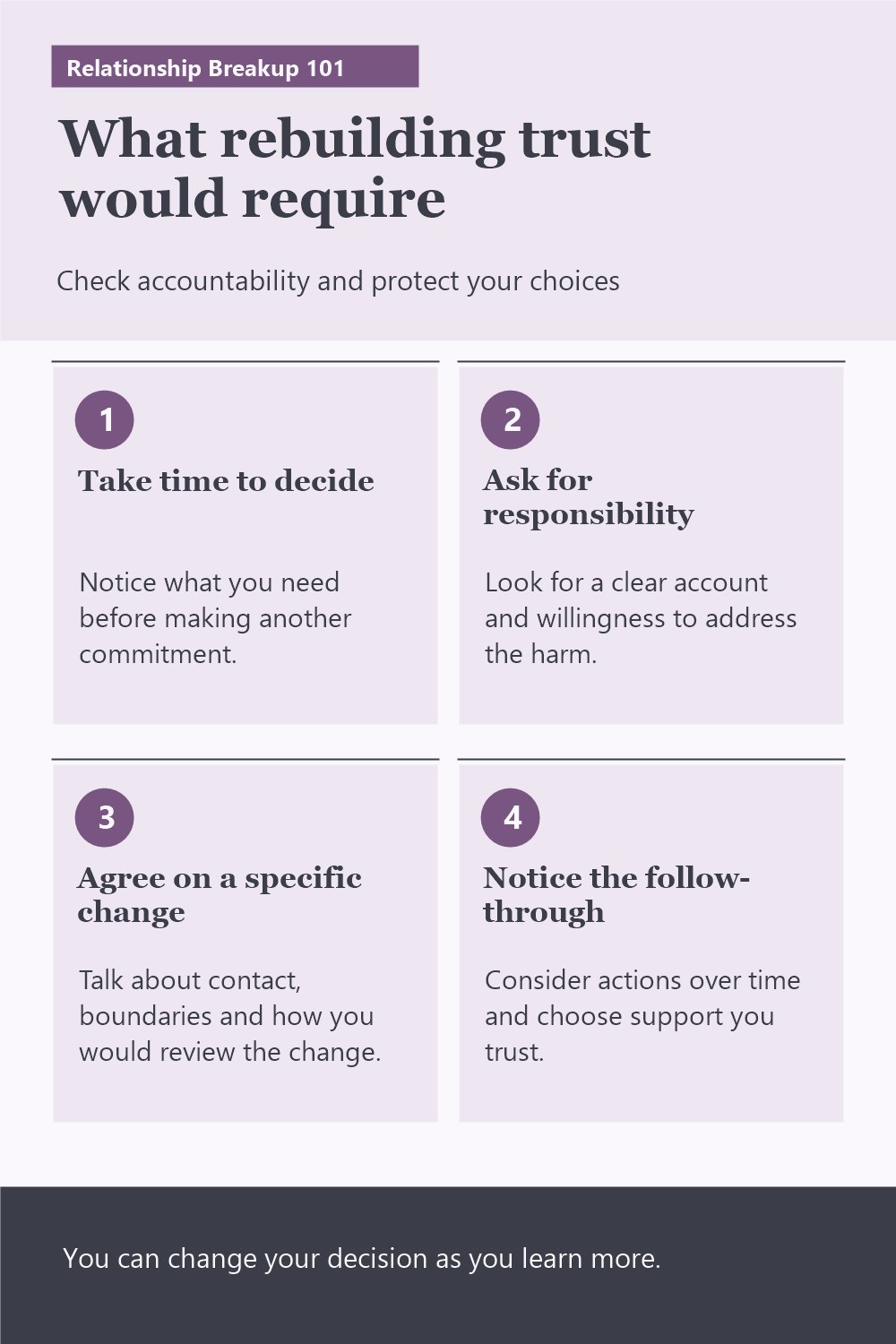
What rebuilding trust would require
Check accountability and protect your choices
- Take time to decide Notice what you need before making another commitment.
- Ask for responsibility Look for a clear account and willingness to address the harm.
- Agree on a specific change Talk about contact, boundaries and how you would review the change.
- Notice the follow-through Consider actions over time and choose support you trust.
You can change your decision as you learn more.