

An on-and-off relationship can mean several things: repeated breakups, an agreed period apart, or a casual arrangement that both people want. Those situations need different conversations. The label alone does not tell you whether the arrangement is respectful or workable.
Start by asking what is actually happening and whether both of you have freely agreed to it. Being busy, missing each other or having a strong connection does not remove the need for clarity.
On this page
- Name the arrangement you are discussing
- Ask whether you want the same kind of relationship
- Discuss practical boundaries before taking a break
- Use the space to consider your own needs
- Make communication predictable where possible
- Compare the pattern with what has changed
- Treat fear and control as a separate concern
- Choose what you are willing to continue

Name the arrangement you are discussing
A planned break has some shared understanding about its purpose. A breakup ends the relationship, even if one person hopes to reconnect later. Repeatedly declaring a breakup during arguments can leave the status unclear and the same concern unresolved.
Try a plain question: “Are we ending the relationship, or are we agreeing to time apart while we decide what comes next?” If you cannot reach a shared answer, avoid assuming that the other person has accepted the arrangement you prefer.
Ask whether you want the same kind of relationship
One person may want an exclusive partnership while the other wants occasional dating. Neither travel nor a demanding job automatically makes an on-and-off arrangement the best choice. Ask what each person can offer and what each person wants.
You might be happy with a casual relationship, need a more consistent commitment or want to stop dating this person. An agreement works only while both people choose it; you do not have to accept a smaller relationship to keep someone in your life.
Discuss practical boundaries before taking a break
If you both want time apart, discuss contact, whether you will date other people, shared responsibilities and when you will next talk. Do not assume that “a break” means the same thing to both of you.
Be specific without trying to control someone’s private life: “I will not be available for personal calls this week; please email about the flat.” A time to review the situation is an opportunity to talk, not a promise that you will reunite.
Use the space to consider your own needs
Ask what you need to feel clear enough to decide: rest, time with friends, practical information or a conversation with someone outside the relationship. Keep room for ordinary life rather than spending the whole break monitoring an ex’s activity.
Write down what led to the separation and what you would need to see change. Include what is within your control and what belongs to the other person. You cannot make an agreement on their behalf or do their part for them.
Make communication predictable where possible
Agree on a suitable route for necessary communication. If a message concerns a bill or a child’s arrangements, keep that exchange focused on the practical issue. Avoid using shared responsibilities as a way to reopen a conversation someone has declined.
If you arrange a discussion, choose a time when you can both participate. It is reasonable to pause a difficult conversation and agree when to return. Withdrawing contact to punish someone or repeatedly demanding an immediate answer makes it harder to choose freely.
Compare the pattern with what has changed
Look at the sequence: what happens before a breakup, what brings you back together and what follows the reunion. Familiarity or a few affectionate days can feel reassuring while leaving the original disagreement untouched.
Ask for a concrete example of a change rather than a broad promise that things will be different. If the same problem keeps returning, you can reconsider the arrangement without calling yourself foolish for having hoped it would work.
Treat fear and control as a separate concern
Threats, intimidation, pressure or monitoring need more than a clearer relationship label. If you are afraid of someone’s reaction, seek individual support before announcing a break, meeting alone or changing contact arrangements.
The US National Domestic Violence Hotline offers personal safety-planning guidance. A local specialist service can help you consider your circumstances elsewhere. You do not have to resolve the whole relationship before asking for help.
Choose what you are willing to continue
You may decide to clarify the arrangement, discuss a possible reconciliation or end the cycle. A useful next sentence is, “This is what I can offer, and this is what I am no longer willing to do.” You are describing your participation, not demanding that someone feel a particular way.
If you are considering getting back together, focus on the specific disagreement and the changes you would both need. If you are stepping away, give yourself room to miss the person without treating that feeling as an instruction to return.
Write out the last cycle in three sentences
You might write “We separated after a series of cancelled plans, reconnected through late-night messages and never discussed how to make time for each other.” That gives you a concrete issue to consider instead of judging how often you’ve returned.
Ask whether either of you wants to change what happened. If the pattern includes threats, pressure or surveillance, consider confidential help before trying a new agreement.
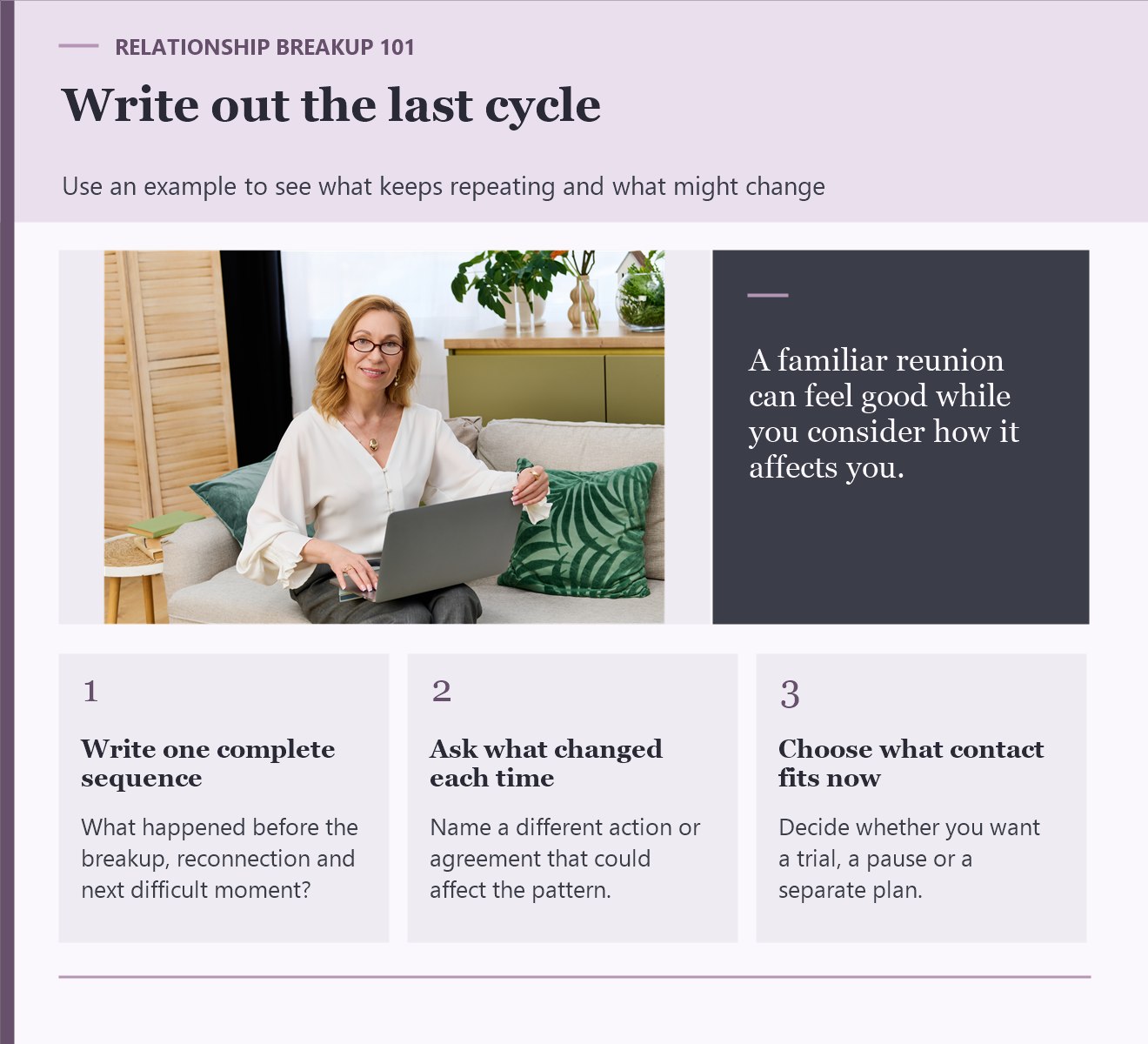
Read the infographic in text
Write out the last cycle
Use an example to see what keeps repeating and what might change
- Write one complete sequence What happened before the breakup, reconnection and next difficult moment?
- Ask what changed each time Name a different action or agreement that could affect the pattern.
- Choose what contact fits now Decide whether you want a trial, a pause or a separate plan.
A familiar reunion can feel good while you consider how it affects you.