

An invitation to try again can bring hope, relief and uncertainty at the same time. You may miss the person and still have good reasons to question whether returning would work for you.
Before restarting the relationship, consider what ended it and what would be different now. A conversation can help you decide; it does not commit you to a reunion or require you to offer another chance.
On this page
Check whether you want the same future
Ask what “trying again” means: dating slowly, returning to an exclusive relationship, living together or discussing a longer-term commitment. Make room for each person’s answer rather than assuming the old arrangement will resume.
Return to the issue that separated you. If it involved children, where to live or the kind of commitment you wanted, ask whether either person’s wishes have actually changed. Strong feelings cannot make two mutually exclusive plans fit.
You might say, “I still care about you, but I want to understand what you are choosing now.” An uncertain or incompatible answer is information you can use, not a problem you must persuade someone to solve.

Look for specific changes rather than a fresh promise
Name the behaviour or practical difficulty at issue. “We need to communicate better” is broad. “We will agree before making plans that affect both of us” gives you something clearer to discuss.
Ask what has already happened and what remains a hope. Someone saying they will seek help is different from having begun to address a problem. You can appreciate an effort without deciding that trust is restored.
An apology should not require you to minimise what happened or accept blame for another person’s harmful behaviour. You remain free to decline reconciliation even when the other person expresses regret.
Keep the pace and boundaries open to choice
Decide what contact feels manageable and which commitments you are ready to consider. You do not have to move back in, combine money or resume intimacy to show that you are taking the possibility seriously.
Discuss exclusivity and contact with other people before making assumptions. Consent to one meeting or conversation does not establish consent to a relationship, sexual activity or access to your private accounts.
If a boundary leads to threats, repeated pressure or fear, pause the reconciliation discussion and seek individual support. A familiar person or an affectionate reunion does not automatically mean that the situation is safe.
Agree on a practical change and a time to review it
If you both want to continue, choose an agreement you can describe plainly. For example: “We will discuss overnight plans before inviting guests,” or “We will return to a paused conversation the next evening if we both feel able.”
Consider what might make the agreement difficult and how you will raise a concern. Pick a suitable time to ask whether the change is working. Avoid making one person responsible for managing both people’s behaviour.
The review is not a test you have to pass to earn love. It is a chance to notice whether the relationship you are rebuilding is one you both want. Either person can decide not to continue.
Make room for the answer you reach
You may decide to meet again, take more time or remain separated. Missing someone does not make any of those decisions dishonest. Keep trusted people and ordinary routines in your life while you consider the choice.
If there has been abuse, do not treat a reunion conversation as your safety plan. The US National Domestic Violence Hotline has personal safety-planning information; a local specialist can help you consider support where you live.
You can value the relationship’s good memories without restarting it. A decision to try again should have room for your judgment, boundaries and freedom to change your mind.
Before a reunion, ask about an ordinary decision
If distance or a recurring schedule problem made the relationship hard, ask how it would work this month. Who could travel, how often would you choose to meet, and what could change if work becomes busy again?
If you both want to try again, choose the first step and a chance to check in. If one person wants something different, respect the decision and consider what kind of contact you want instead.
Read the infographic in text
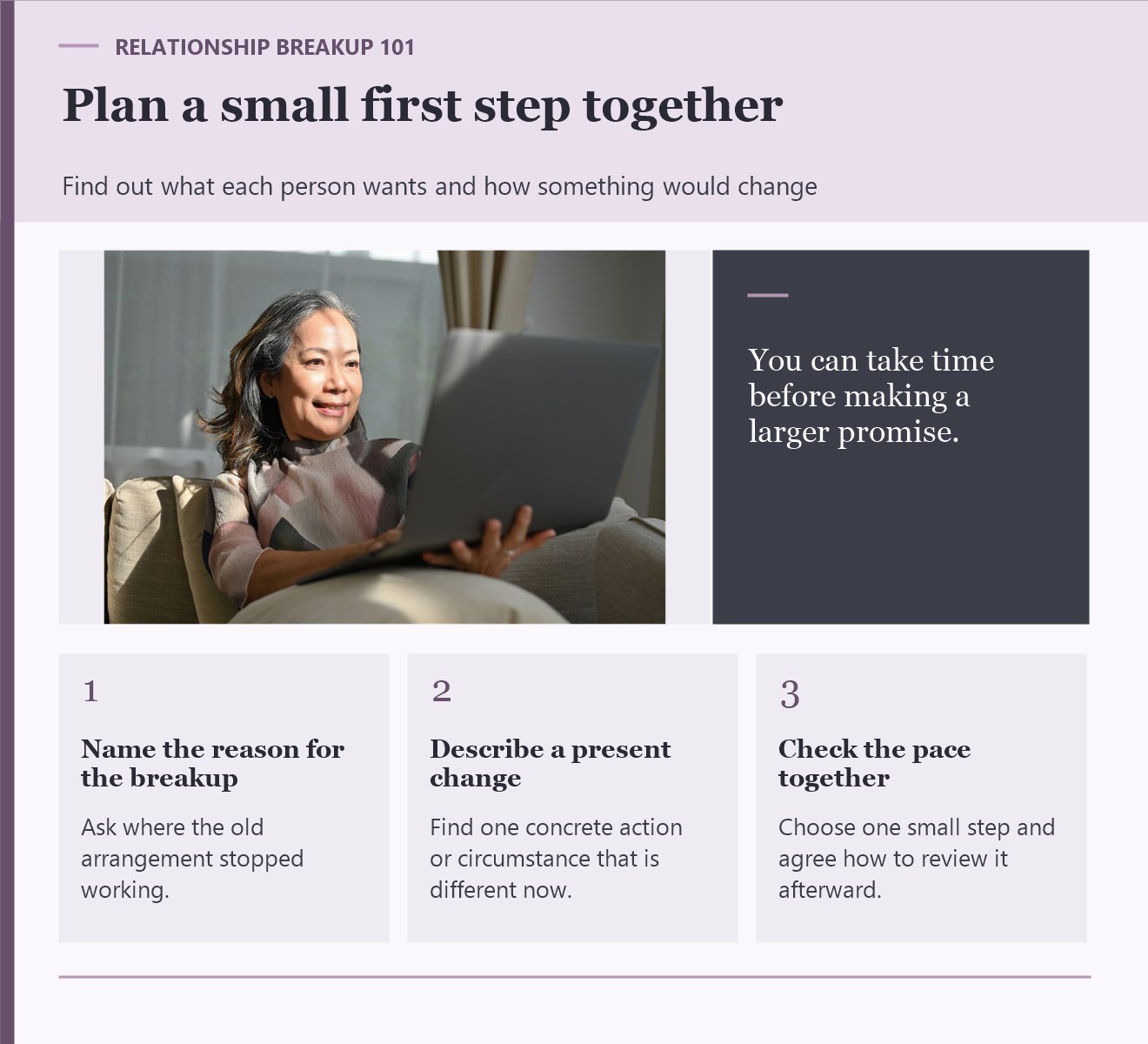
Plan a small first step together
Find out what each person wants and how something would change
- Name the reason for the breakup Ask where the old arrangement stopped working.
- Describe a present change Find one concrete action or circumstance that is different now.
- Check the pace together Choose one small step and agree how to review it afterward.
You can take time before making a larger promise.