

If you are asking whether to divorce, a simple list of signs cannot decide the answer for you. You may be facing a long-standing problem, a recent crisis, incompatible plans or a relationship in which you feel unsafe. Each situation calls for different information and support.
Begin with the question you need answered next. That may be whether change is possible, what separation would involve or how to get help privately. You can gather information without treating it as a commitment to a particular outcome.
On this page
1. Describe the problem in specific terms
Replace “our marriage is broken” with what is happening: repeated dishonesty, unequal responsibilities, different wishes about children, lost connection or fear of a partner’s response. Note how long it has been happening and what has already been tried.
Separate what you know from what you hope or fear will happen. A clearer description can help you explain the situation to a trusted person or qualified adviser. You do not need to decide whether your experience is bad enough compared with someone else’s.

2. Consider safety before a joint conversation
If there are threats, coercion, monitoring or violence, a private discussion with a domestic abuse service may be a more suitable first step than announcing your plans or arranging joint counselling. Consider whether the device and place you use to seek help are safe.
Where you can both speak freely, you might discuss what each person wants and whether there is a shared wish to work on the relationship. Counselling is an option to consider, not a requirement you must complete before choosing separation.
3. Find qualified information for your location
Divorce rules, finances, housing and arrangements for children depend on your circumstances and location. Write down the questions you need answered and seek advice from an appropriately qualified local professional or official service. A friend’s experience may not describe your position.
In the U.S., USA.gov lists ways to find legal aid; elsewhere, check official local court or legal-aid resources. Availability and eligibility vary. Avoid assuming that leaving a home, moving money or signing an agreement has no consequences.
4. Identify the everyday arrangements you would need
Consider housing, income, bills, medicines, transport and care responsibilities. If children are involved, think about their routines and the information or specialist advice needed to make appropriate arrangements. Keep children out of the role of messenger or decision-maker between adults.
An information list is not a demand to solve everything at once. Mark what is known, what needs checking and what is urgent. If you cannot safely access documents or money, ask a support service or qualified adviser about your options rather than taking a risky step to complete the list.
5. Be specific if you are considering change together
If you both want to continue the marriage, describe the changes that matter in observable terms. “Share the weekly care tasks” is more concrete than “try harder.” Consider who will do what, what support is needed and when you will discuss progress.
Promises do not guarantee sustained change. Notice actions over time and whether you can raise concerns freely. You are allowed to reconsider an arrangement that is not working; staying temporarily to gather information does not obligate you to stay indefinitely.
6. Choose one manageable next step
Your next step might be a private advice appointment, a conversation with a trusted person, an individual counselling session or a practical budget. Choose the action that addresses the uncertainty you have identified, rather than trying to settle your entire future today.
Separation or divorce does not guarantee either conflict or a friendly ending. Aim for informed decisions and appropriate support. You can acknowledge grief, relief and uncertainty without treating any one feeling as proof that you should stay or leave.
Prepare what you can for a first appointment
Write down what you want to ask, such as what happens to a shared lease or what information a lawyer needs about existing childcare arrangements. Bring relevant paperwork you can access safely. You can note missing information instead of trying to get it in a way that puts you at risk.
Legal Aid BC has a checklist for preparing to meet a family lawyer that illustrates what this can look like in British Columbia. Seek guidance from an appropriate service where you live.
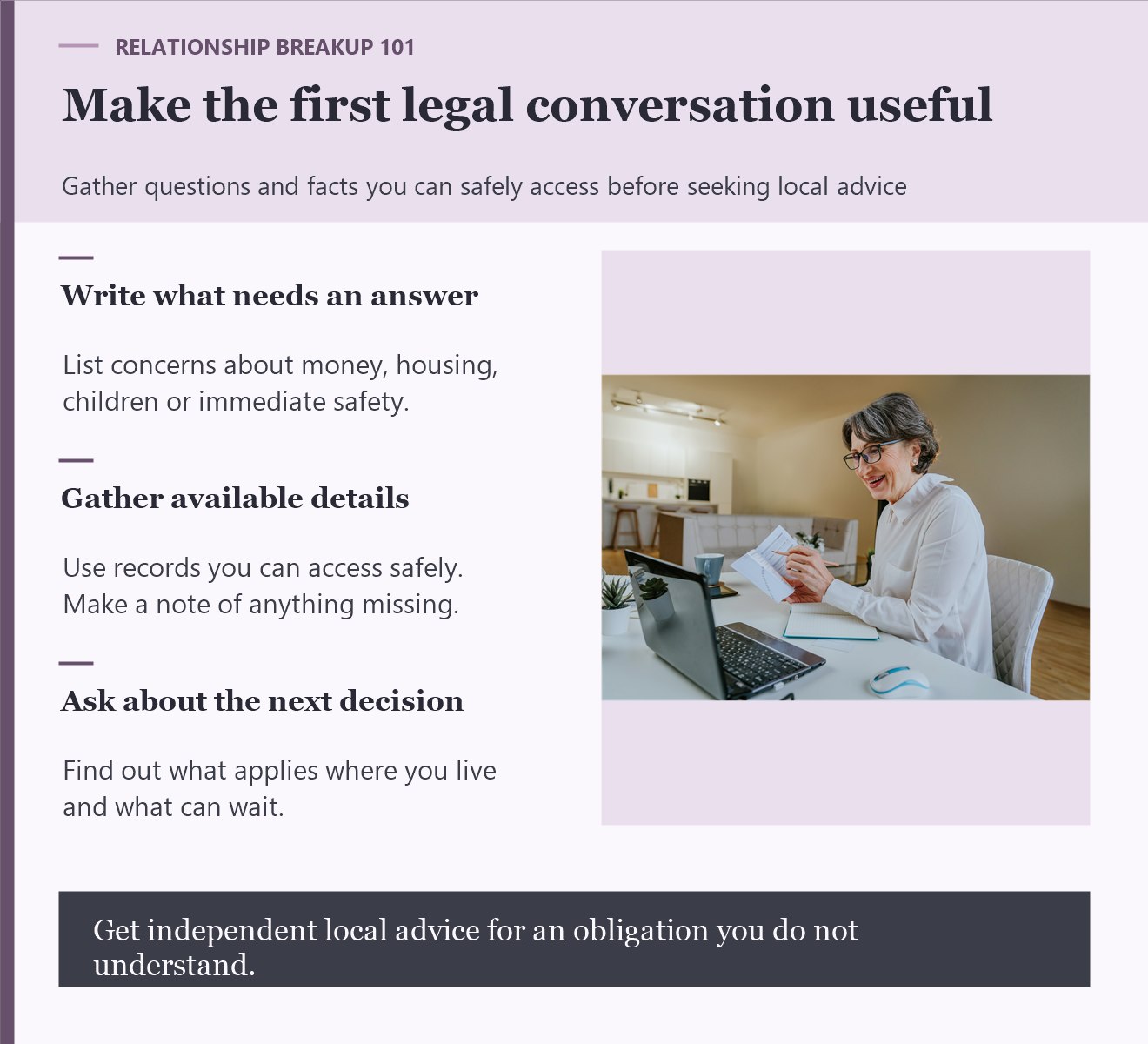
Read the infographic in text
Make the first legal conversation useful
Gather questions and facts you can safely access before seeking local advice
- Write what needs an answer List concerns about money, housing, children or immediate safety.
- Gather available details Use records you can access safely. Make a note of anything missing.
- Ask about the next decision Find out what applies where you live and what can wait.
Get independent local advice for an obligation you do not understand.
Frequently asked questions
1. What should I write down before speaking to a family lawyer?
List your main questions about housing, children, shared finances, next deadlines and safety. Bring a short account of what has happened and note any agreements or documents that might matter.
2. Do I need all the paperwork before asking for help?
You can ask for advice with what you already have. Note where information is missing and tell the adviser if you cannot safely access it.
3. Should I speak to a lawyer from the place where I live?
Seek qualified advice for the location where your situation will be handled. A local legal information service or family lawyer can explain what applies or refer you to someone appropriate.
4. What if I’m worried my partner will find out that I asked for advice?
If you suspect monitoring or fear retaliation, use a safer contact method if possible. You can also speak privately with a family violence advocate about how to get help and think through your safety.
5. Should I wait until I decide whether to separate before getting information?
You can gather information while you consider your options. Tell the person you consult which decisions are still open and which issues have a deadline.