

The first 48 hours after a breakup do not have to produce closure or a new life plan. A smaller aim is enough: somewhere safe to be, food and rest, one supportive person and a way to handle responsibilities that cannot wait.
You may feel grief, relief, anger, numbness or several things at once. Use this as a flexible plan for the next two days, rather than a deadline for feeling better.
A manageable plan for the next two days
Read the guide as text
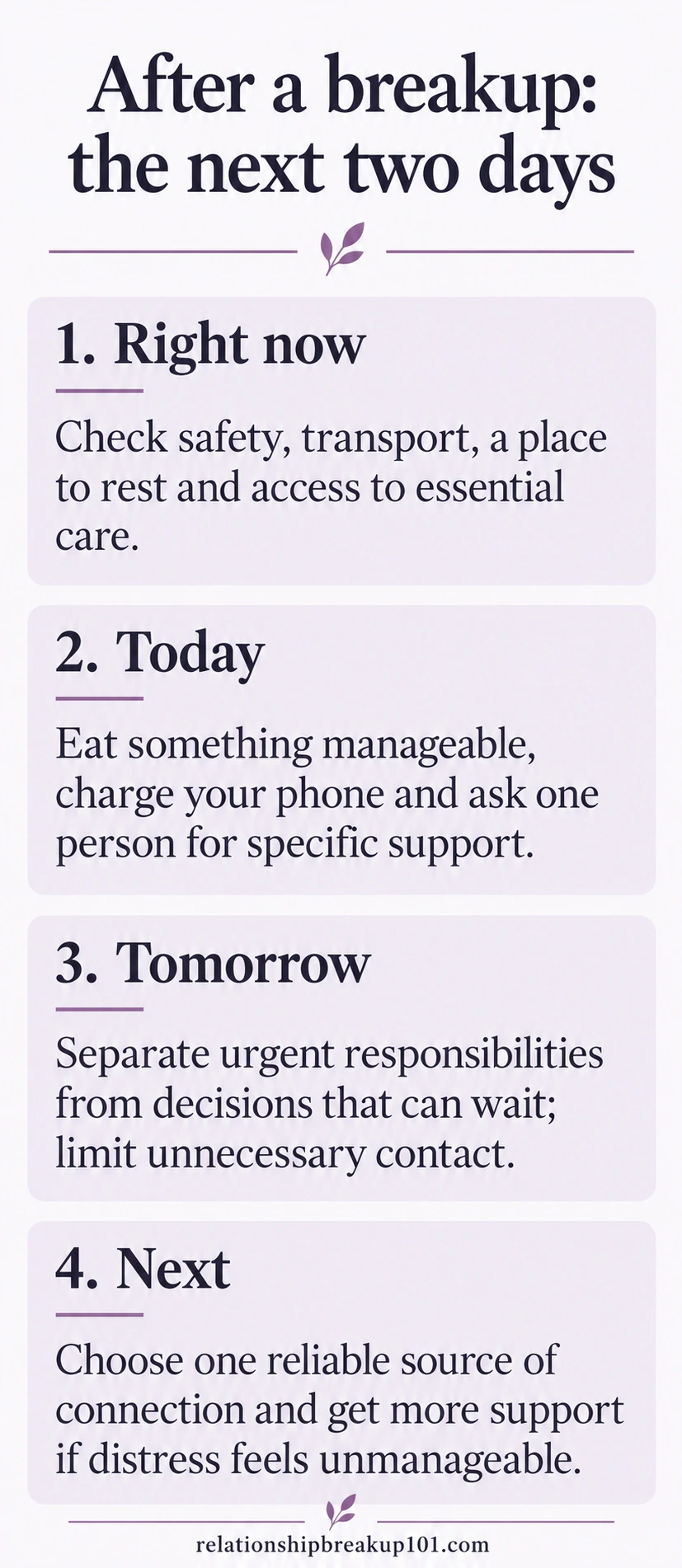
- Right now. Check safety, transport, a place to rest and access to essential care.
- Today. Eat something manageable, charge your phone and ask one person for specific support.
- Tomorrow. Separate urgent responsibilities from decisions that can wait; limit unnecessary contact.
- Next. Choose one reliable source of connection and get more support if distress feels unmanageable.
Find Out What You Need Now
Ask yourself where you can be for the next few hours. Are you safe? Do you need someone to give you a ride, somewhere to sleep, or access to your medicine?
If your ex is threatening you, stalking, or controlling you, put your safety first. You don't owe an in-person closure conversation. If you're in immediate danger, contact local emergency services right away.
Being too exhausted can make it unsafe for you to drive. If this is the case, find another way to get home or wait somewhere safe. You don't have to get home by your usual method just because that was the plan.
If you find that your relationship is over while you're visiting your partner in another town, your first decision might be to ask yourself where you can spend the night and how you'll get home the next day. Understanding why the breakup happened can wait until these specific needs are covered.
Getting the Support You Need
Pick someone who can hear what you're saying without turning it into an emergency investigation or an argument about your ex. You might tell them, "We broke up, and I don't need your advice yet, but can you stay on the phone while I make dinner?" or "Can you help me decide what I can tell work tomorrow?"
It's easier to respond to specific requests than to understand general statements saying that you're not okay. Specific requests let you get the support you need without having to tell the entire story.
If you don't have a close friend who's available, talk to a family member, counselor, or community service provider, or find a support contact. You aren't failing because your support network is small. The purpose is to make a connection, not to get a circle of people in the next hour.
Take Time and Lower Your Standards for Today
You can lower your standards for today, and you don't have to be productive. Pick food that's easy to make, put the necessary items where you can find them, and put off tasks that can wait. If you take medicine, take it as instructed, and don't change your doses or mix substances to help you sleep. If sleep or stress feels unmanageable, get advice from a healthcare professional.
NIMH’s mental health care guidance includes sleep, regular meals, manageable priorities and supportive contact. These basics are supports, not a cure for heartbreak or a measure of how well you are coping.

Writing down a list for this time might only have three items, such as eating something, charging your phone, and picking where you're going to rest. Leave your big goals, such as reorganizing the house or writing a letter, for another day.
Give Yourself a Break from Checking Your Phone
After a breakup, it can be hard to stop checking your phone, especially if you're used to talking to your ex throughout the day. You might find yourself reading old messages, checking whether they're online, or wanting to send a text whenever something reminds you of them. While these feelings are understandable, constantly checking your phone can make it harder to focus on yourself and begin moving forward.
Instead of expecting yourself to stop these habits overnight, try making a few small changes. You might mute your ex's messages, leave your phone in another room while you're eating dinner, or spend time with a friend during the hours you would normally talk to your partner. These little changes can help you break some of the habits you've developed without putting too much pressure on yourself.
But remember that cutting off every form of communication isn't always realistic. If you and your ex have children together, share a home, or have responsibilities involving work or finances, you might still need to communicate about certain things. The goal is to create some emotional distance while keeping the communication you genuinely need.
It's also a good idea to think about shared passwords, accounts, and location settings. If your relationship wasn't abusive, reviewing who has access to your information can be a practical step after a breakup. But if your ex has monitored your phone, controlled your activities, or threatened you in the past, making sudden changes could create safety concerns. In these situations, talking privately with a professional who understands abusive relationships can help you figure out a safer way to protect your information.
Decide How Much Contact You're Comfortable Having
After a breakup, you don't have to immediately decide whether you'll ever speak to your ex again. Sometimes it's easier to focus on what you need for the next few days instead of trying to figure out what your relationship will look like months or years from now.
You might need a little time without having emotional conversations with your ex. You could say something like, "I need some space until Friday. If we need to discuss the rent or picking up belongings, please email me." This explains what you're comfortable with while still allowing important responsibilities to be handled. But if contacting your ex could put you in danger, you don't have to send a message just to explain your boundaries.
If you share children, a home, or other responsibilities, completely avoiding contact might not be possible. In these situations, try keeping conversations focused on what needs to be done. You can discuss schedules, bills, or other necessary arrangements without bringing every emotional concern into the conversation.
If you find yourself wanting to ask questions about the breakup or explain how you're feeling, consider writing those thoughts down instead of immediately sending them. You can come back to them later when you've had more time to think about whether the conversation would actually help you.
It's also important to remember that taking a break from communication shouldn't be about making your ex miss you or hoping that ignoring them will convince them to come back. You can't control whether distance changes someone else's feelings. But you can decide what kind of contact you're emotionally ready to handle.
The important thing is giving yourself enough space to begin adjusting to the breakup while still taking care of your everyday responsibilities. You don't have to figure everything out at once. Sometimes focusing on what you need right now is a good place to start.
Writing the Message without Sending It
You might have things you want to say, such as an accusation, an apology, a question, or a plea. Writing these things down can help you get your thoughts together without meaning that you have to send it right away. Write in a private notebook or draft it outside a message thread. If privacy is limited, pick a safe way to process your feelings. You don't need a written record if it could cause harm.
Ask what the sentences are trying to achieve. Is it requesting information, expressing grief, getting reassurance, or trying to restart a relationship? Different needs need different support.
Say that you decide to write a long message asking why the breakup happened. Then you realize right away that all you need is to talk to someone, and you call your sister instead. You can still decide later whether you want to ask the question and send it to your ex, without making a fast decision.
Make a Daily Plan
Morning can bring a new wave of shock when you remember what has changed. Before you look at your whole future, find out what the day requires from you. Write down your commitments, tasks that you can do now, and tasks that can wait. You might need to pick up a kid, go to a medical appointment, or tell work that you're not available today.
You don't have to share private details with your employer. Ask what leave or scheduling options are available. You can keep personal details limited while following the information requirements of your workplace; arrangements and entitlements vary.
If you end up having to work, pick the next task and take a short break when possible. A hard day that is done at a lower standard can still be managed.
Take Care of Important Responsibilities Without Reopening the Breakup
After a breakup, there might still be things you and your ex need to work out. Maybe you have belongings at each other's homes, share bills, have pets together, or need to discuss living arrangements. While these things are important, try to keep practical conversations separate from discussions about what went wrong in the relationship.
When you need to contact your ex about something, keep the message simple and explain exactly what you need. For example, you might say, "I need to pick up my work laptop tomorrow. Could you leave it at the front desk by noon? Please let me know if that works." This helps you take care of the situation without turning the conversation into another argument about the breakup.
But remember that your safety comes first. If you're uncomfortable or afraid of seeing your ex, don't feel that you have to collect your belongings alone. Consider asking someone you trust for help or getting appropriate local support. If you're dealing with disagreements about housing, property, finances, or children, getting qualified legal advice before making major decisions might also be helpful.
One thing that can make this process easier is writing down everything that still needs to be handled. Start with the things that can't wait, such as paying rent, returning important keys, or collecting something you need for work. Other decisions, like those who gets certain furniture or decorations, might be able to wait until emotions have settled.
You don't have to figure out every little detail immediately. Taking care of the most important responsibilities first can help you avoid unnecessary arguments while giving yourself time to adjust to the breakup.
Help Your Children Feel Secure During the Changes
When a relationship ends and children are involved, it's important to think about how the changes might affect them. Children often have practical questions about what's going to happen next. They might wonder where they'll be sleeping, who will pick them up from school, or whether they'll still get to enjoy their usual activities.
Try to explain what's happening in a way that makes sense for their age without sharing personal details about the breakup. You don't need to tell them everything that happened between you and your ex. Instead, focus on the information they need to feel supported and understand what changes they can expect.
It's also important not to make promises about things you're still figuring out. For example, instead of telling your children that nothing will change, you might say, "We're still working out some of the plans, but we'll let you know when we have more information." This allows you to be honest without making them worry about decisions that haven't been made yet.
Remember that children shouldn't be responsible for handling problems between adults. Don't ask them to pass messages to your ex, tell you what's happening at the other parent's home, or reassure you that ending the relationship was the right decision. Even when you're feeling hurt or overwhelmed, it's important to find support from other adults instead of putting that responsibility on your children.
If you and the other parent can communicate safely and respectfully, talking with your children together might help provide a consistent explanation. But if the relationship involved abuse, threats, or legal restrictions on contact, getting professional guidance before arranging a joint conversation is a safer approach.
The most important thing is helping your children feel loved and supported while everyone adjusts. You might not have every answer right away, but keeping their routines as consistent as possible and giving them honest, age-appropriate information can help them feel more secure during a difficult time.
Allow for Grief
The end of a relationship can involve a sense of loss. Reactions vary, and there is no correct sequence of feelings you must follow. You might miss the person, the routine, the future you hoped for, or a part of yourself that you felt in the relationship. Talking about the loss can help you find comfort that fits your life.
If your evenings feel lonely, talk to a friend or do an activity during that time. A familiar voice or a small shared activity may make a difficult evening more manageable, even while the future remains uncertain.
You don't have to learn a lesson, feel thankful, or forgive anyone in 48 hours. Allow the feeling to exist because it doesn't require you to agree with every suggestion or conclusion right now.
Take a Break Before Making Decisions
Before you move away, resign, or spend a lot of money, ask if the decision needs to happen right now. Some decisions are urgent, especially those that involve safety, shelter, health, or children, but others can be more clear with time, information, and conversations with someone who cares about you.
Ask yourself these things: “What problem would this solve?” “What could it make harder?” and “Can I take smaller steps that are reversible first?” These are reflections and not rules that stop you from changing.
If you want to delete every picture immediately, one alternative is to move them out of everyday view and revisit the choice later. Another person might want to delete them, and the point is that you get to choose what you want to do.
Getting Help When Needed
Get professional help if the stress is making it hard for you to sleep, eat, function, or deal with your responsibilities. You don't have to wait a certain amount of time if the symptoms are severe.
If you have thoughts of suicide, feel unable to keep yourself safe, or may act on an urge to harm yourself, seek immediate help. In the United States, call or text 988; the 988 Lifeline explains what to expect. Elsewhere, contact your local crisis service. In an immediate life-threatening emergency, call the local emergency number.
If you can, tell someone you trust that you need help or company. Don't rely on an ex-partner as part of your safety plan. Asking for help doesn't mean you're weak or that the breakup defines who you are. It just means your stress deserves to be cared about.
Creating a Plan
When you have some space to think, choose one or two supports you could use again. This might mean that you go out to eat with a friend, go to counseling, get a call, or set a bedtime routine.
Pick one practical priority and one source of connection. Allow yourself to rest because you don't need to change your life to show that you're moving forward. Pay attention to what helped you, even if it was just a little. Was putting the phone away during dinner or having someone close to you helpful? Find out what was useful and do it again instead of judging yourself on some kind of timeline.
The first two days after a breakup are a time when you need gentleness and to make some decisions. You can still be uncertain and care about yourself. A good next step is enough, and the bigger picture will come as time goes on.
Choose a small breakup-support plan
Pick the area that feels hardest today for a short plan you can adapt. There is no recovery deadline.
If there is immediate danger or you may harm yourself or someone else, seek local emergency or crisis help now.
Use the questions and examples in the article above; the draft builder needs JavaScript.
15 questions readers ask
1. Do I need to feel better after 48 hours?
No. Two days is a planning window, not a recovery deadline. The aim is to cover immediate needs and find support while leaving room for your feelings.
2. What should I do first?
Check where you can safely be, how you will get there and whether you have essential medication or care. Then choose one manageable task, such as eating or contacting someone.
3. Is it unusual to feel relieved and sad together?
Those feelings can coexist. A breakup can end something difficult while also involving loss. You do not need one consistent emotion to justify what you need.
4. What if I feel numb?
You do not have to force an emotional reaction. Focus on ordinary needs and support. Seek professional advice if symptoms or functioning concern you.
5. Should I ask for a closure conversation immediately?
You can wait. Consider what you want from the conversation and whether it is safe and likely to be useful. You do not owe an in-person meeting.
6. Do I have to block my ex?
No single contact rule fits everyone. You can mute optional updates or set a temporary boundary while preserving necessary channels for children, housing or other obligations.
7. How can I limit contact without deciding forever?
If safe, state a temporary arrangement with a review point and a channel for necessary matters. For example, request space for several days while keeping rent-related messages in email.
8. What can I ask a friend to do?
Ask for something concrete: company during dinner, a lift, help sorting urgent tasks or a short check-in. You can request listening without advice.
9. Should I tell work what happened?
You can keep details private while asking about available leave or schedule changes. Follow workplace requirements and avoid assuming that every requested change will be available.
10. What about belongings and shared bills?
List what needs action soon and what can wait. Keep requests specific and separate from relationship arguments. Get appropriate advice before major housing, financial or parenting changes.
11. Should children hear the full explanation?
Give age-appropriate practical information and reassurance that adult decisions are not their fault. Avoid intimate details, promises you cannot confirm and using children to carry messages.
12. Can I write a message without sending it?
Yes, if keeping a draft is safe for you. Writing can clarify whether you need information, expression or support. You can decide later whether sending it serves that need.
13. Should I make a major life change right away?
Address urgent safety and care needs first. Where possible, give major spending, resignation or relocation decisions more time and information. Smaller reversible steps may be useful.
14. When should I seek professional help?
Seek help when distress, sleep, eating or daily functioning concerns you. Severe symptoms deserve attention promptly; you do not need to wait for a set recovery period.
15. What if I might harm myself or cannot stay safe?
Seek immediate help and, when possible, tell a trusted person you need support. In the United States, call or text 988. Use local emergency services for immediate life-threatening danger; elsewhere contact your local crisis service.