

When a relationship feels strained, you may wonder whether to try again or let it end. You do not have to prove that you worked hard enough before you can leave. If you want to explore repair, make the effort specific and leave room for either answer.
These questions can help you decide what to discuss. They are not a test that scores whether a relationship deserves saving, and they cannot promise that affection or trust will return.
On this page
1. Can you raise concerns and say no safely?
Start with what happens when you disagree. Can you describe a problem without being threatened, monitored, humiliated or punished? Are your boundaries respected even when your partner is disappointed?
If you are afraid of their reaction, seek individual support before planning a relationship conversation. The answer is not to become more agreeable or affectionate to prevent harm. You can put safety and practical support ahead of deciding whether to repair the partnership.

2. What exactly needs to change?
Choose one or two patterns rather than trying to solve everything at once. “We never connect” might become “We spend most evenings separately and have not made time to talk.” “You do not help” might become a specific discussion about tasks, time and capacity.
Notice whether the problem is a workable habit or a difference about an essential goal. A new routine may help with missed conversations. It will not necessarily resolve incompatible wishes about children, commitment or where to live. Being clear can prevent effort from going toward a problem neither person actually shares.
3. Do both people freely want to try?
Ask directly rather than relying on memories of a happier period. You might say, “I would like to work on how we handle evenings together. Do you want to try making a plan with me?” Listen to the answer and to what each person is willing to do.
You can take responsibility for your own conduct without accepting responsibility for someone else’s. Becoming calmer or more vulnerable does not guarantee a gentle response. Repair needs participation; one person cannot negotiate on behalf of both.
4. What would a realistic improvement look like?
Agree on an observable change that fits your lives. It could be a short weekly conversation, a fairer task arrangement or a way to pause an argument and return to it. Make the plan modest enough to practise, and discuss what to do if it is not working.
You can choose a time to review the arrangement. Look for a sustained pattern, including how setbacks are handled. Gifts, one pleasant weekend or a heartfelt apology may matter, but they do not by themselves show that the original difficulty has changed.
5. What do you want if the relationship stays much the same?
Consider the partnership you are experiencing now, alongside any hopes for its future. If little changed, would you still choose it? What support or practical planning would you need to stay, take space or leave? You do not need to settle every feeling in one sitting.
Individual counselling may help you clarify your position. If both people want to work together and can speak safely, couples support may be an option too. Whatever you decide, you can value the good parts of the relationship without treating them as an obligation to continue it.
Read the infographic in text
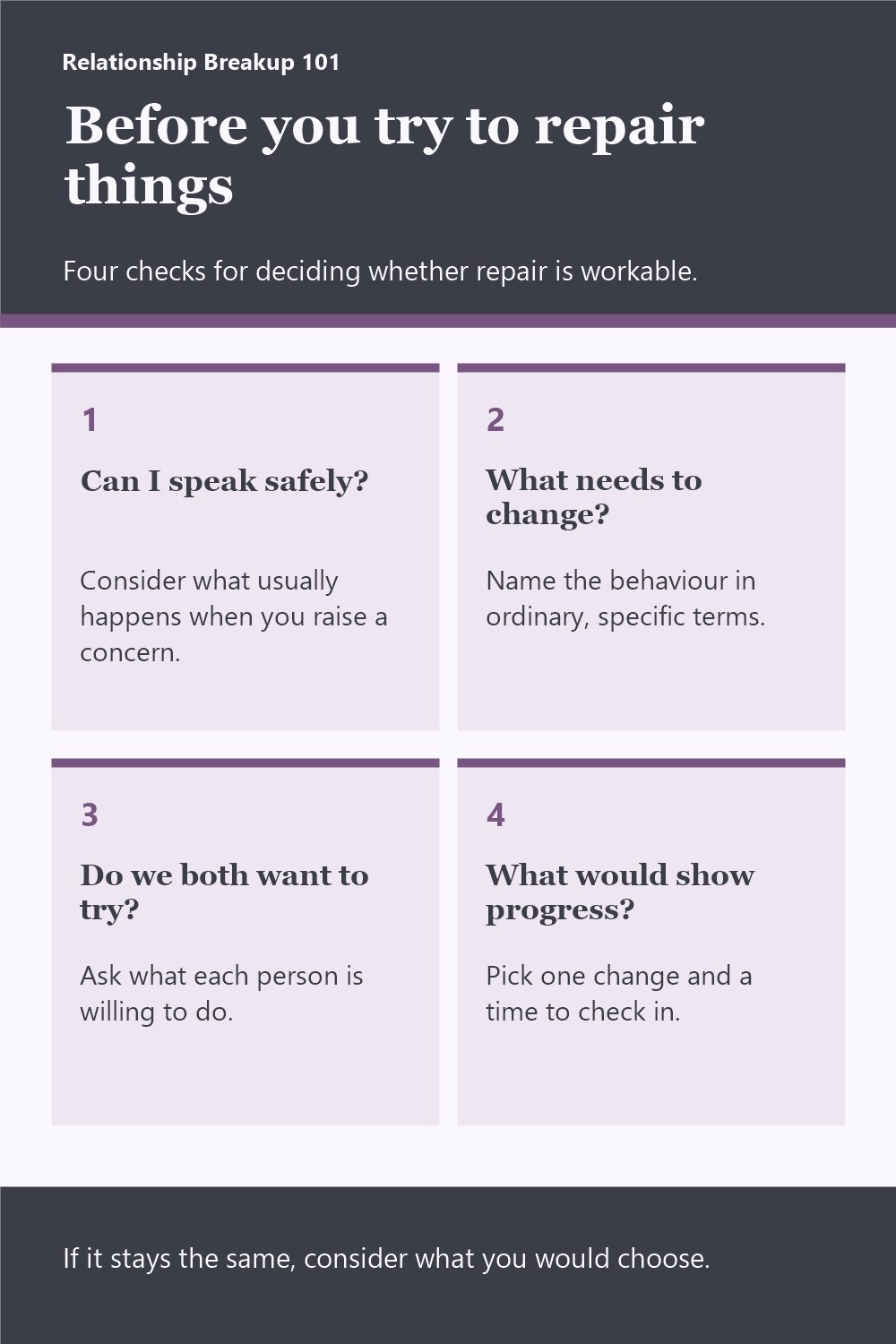
Before you try to repair things Four checks for deciding whether repair is workable.
- Can I speak safely? Consider what usually happens when you raise a concern.
- What needs to change? Name the behaviour in ordinary, specific terms.
- Do we both want to try? Ask what each person is willing to do.
- What would show progress? Pick one change and a time to check in.
If it stays the same, consider what you would choose.