

There may be no moment when ending a relationship feels easy. That does not mean you must speak immediately, or that every delay is dishonest. Safety, housing, caring responsibilities and an acute crisis can affect when and how you communicate.
Begin with the difference between still deciding and having decided but needing a plan. These are different conversations. A considerate approach is clear about what is known while leaving room to prepare the practical details.
On this page
Know which decision you are making
If you are unsure about staying together, name the actual issue: an unmet need, a conflict, a change in what you want or concern about a recurring pattern. If it feels safe, you might discuss that issue before reaching a decision. You are not required to try every possible repair before leaving.
If your decision is already made, avoid presenting the conversation as a request for your partner to improve. “I am ending our relationship” is clearer than giving conditions you do not intend to reconsider. Your partner may disagree, and disagreement does not invalidate your choice.

Let safety and practical needs shape the plan
Think about where you will be afterwards, transport and access to essentials. If you share a home or care for someone, some arrangements may need planning before the conversation. A practical delay can have a purpose; write down what needs to be arranged and who might help.
If there are threats, stalking, control or a fear of retaliation, an in-person conversation may not be the safest option. Consider specialist help with a plan for your circumstances. The National Domestic Violence Hotline has personal safety-planning guidance. Use a safer device to seek help if monitoring is a concern.
Choose a setting with enough time and an exit
Where safety is not a concern, consider privacy, whether either of you is about to drive or work, and whether the conversation can end without one person being stranded. A public place is not automatically safer or kinder; choose a format that fits the circumstances.
You may choose to avoid delivering the news during a public celebration or an acute emergency when another workable moment is available. But birthdays, holidays and other events do not create an obligation to remain indefinitely. There is no universal number of days that makes the timing correct.
Be direct without promising a painless response
A possible opening is: “I have thought about our relationship, and I have decided to end it. I know this may be upsetting. I want to be clear rather than leave you unsure about my decision.” Adapt that to your situation; do not use a script to hide what you actually mean.
You can offer a brief honest reason without listing every fault or debating every past event. Avoid promising to stay close friends, suggesting a future reunion or saying it is only a break unless those statements are true. Kind wording can help clarity, but it cannot control how the other person feels.
Give a delay a practical purpose, then review it
If you decide to wait, identify the reason and the next action: finding somewhere to stay, arranging care or getting advice about a shared responsibility. Choose a private review point that is realistic for you, rather than turning someone else’s deadline into another source of pressure.
If postponement keeps repeating, ask what remains unresolved. It may be uncertainty about the decision, grief, lack of resources or fear. Those call for different kinds of support. A trusted person can help you make the next step concrete without deciding the relationship for you.
Choose a time and a way to leave afterward
If the decision is made, choose a time when practical needs are covered and neither person is trapped in a car or unable to leave. You may prefer a brief message or call if meeting feels unsafe or invades a boundary.
Think about where you will go afterward and whether a trusted person should know your plan. If the other person has threatened you before, speak privately with a support service about what would be safer.
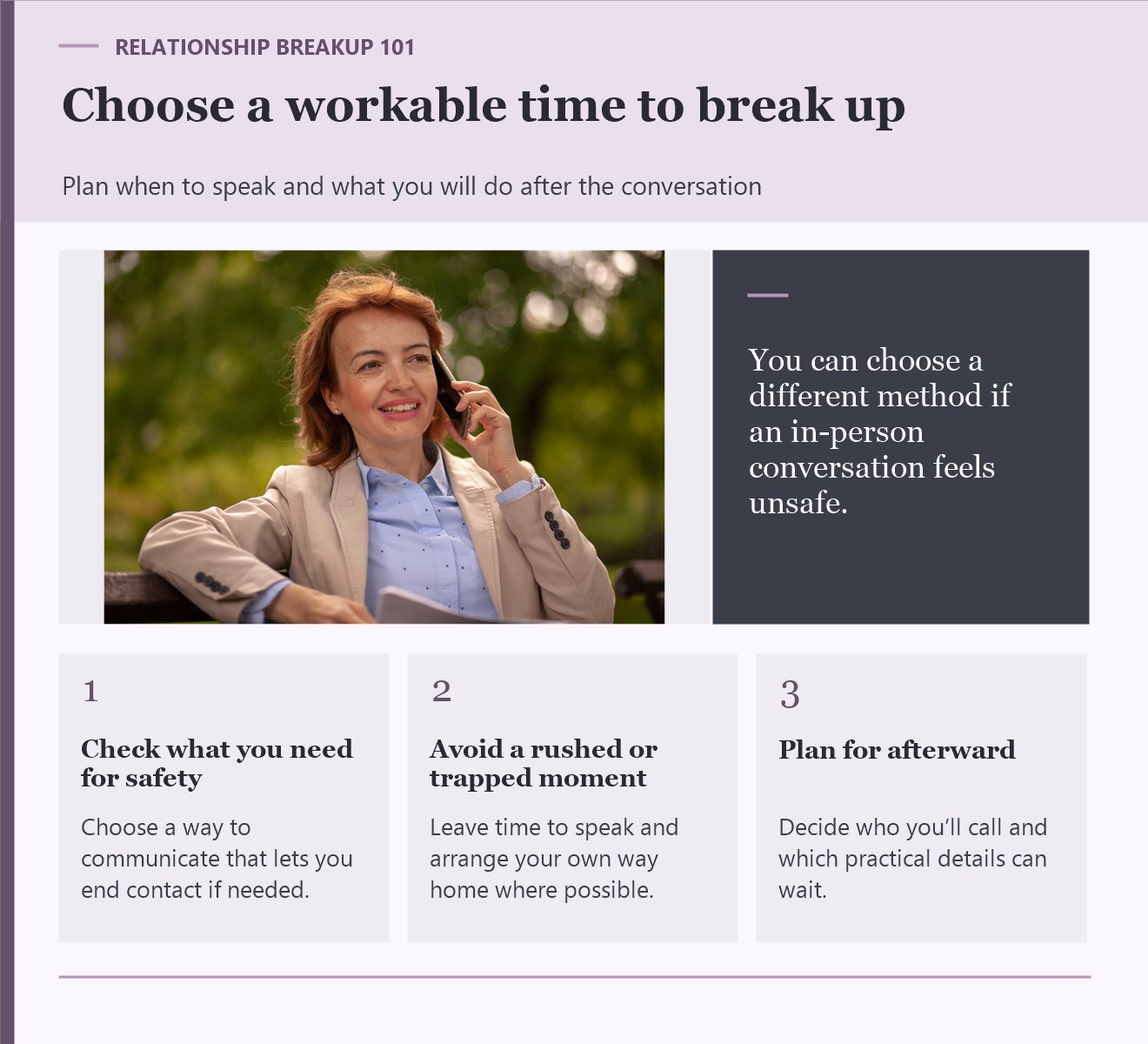
Read the infographic in text
Choose a workable time to break up
Plan when to speak and what you will do after the conversation
- Check what you need for safety Choose a way to communicate that lets you end contact if needed.
- Avoid a rushed or trapped moment Leave time to speak and arrange your own way home where possible.
- Plan for afterward Decide who you’ll call and which practical details can wait.
You can choose a different method if an in-person conversation feels unsafe.