

Wanting reassurance or closeness does not make you a problem. What matters is how you respond to uncertainty and whether both people can keep their privacy, friendships and choices. These questions apply to any partner, regardless of gender.
If repeated messages, checking or arguments about time apart are becoming a pattern, focus on a few specific actions you can change. You can work on your own behaviour and still ask whether the relationship meets your needs.
On this page
1. Notice the action you take when worry rises
Think about a recent moment: a reply was late, a plan changed or your partner went out without you. Separate what happened from what you feared it meant. “They have not replied for two hours” is an observation; “They are about to leave me” is an interpretation.
Then notice your response. Did you send more messages, demand proof or look through an account? A brief pause can give you another option: write the concern privately, step away from the phone or choose one clear message. A feeling is something you can acknowledge without acting on every urge.

2. Ask for something specific instead of setting a test
Try a direct request: “When plans change, could you let me know?” or “I would like us to spend some time together this week. When would work?” A request makes it easier to understand what would help and whether the other person can offer it.
Avoid asking a partner to prove love through constant availability, access to passwords or a correct answer to repeated hypothetical questions. You can ask for reassurance; they can have limits. If your needs remain very different, that difference deserves an honest discussion rather than another test.
3. Address jealousy without policing another person
Jealousy can be uncomfortable. Name the feeling without treating it as evidence of wrongdoing. A partner having friends of another gender, enjoying an activity alone or wanting privacy does not by itself establish dishonesty.
If an actual agreement was broken, discuss that event directly. You do not have to dismiss a real concern as insecurity. At the same time, monitoring messages, banning friendships or trying to make your partner jealous does not create a reliable agreement. Decide what you need and what you will choose if it is not available.
4. Keep connections and activities that belong to you
Choose time for an interest, a trusted friend or a routine you enjoy. It can be modest: a regular call, a class, a creative project or a walk. You do not need an impressive independent life to deserve care.
Consider practical limits such as cost, disability, work or caring responsibilities. The aim is to keep some room for your own choices, with support where needed. Time apart should not become a punishment or a performance designed to provoke attention.
5. Agree on contact and seek support when needed
Discuss what contact feels workable: how you make plans, when you are usually unavailable and how to raise a change. An agreement should leave both people free to say no and should not require one person to report every movement.
The NHS relationship guidance includes boundaries, listening and keeping your own interests. If worry or repeated checking is disrupting daily life, individual professional support may help you explore it. You can also reconsider a relationship where your needs are consistently dismissed or you do not feel safe.
Read the infographic in text
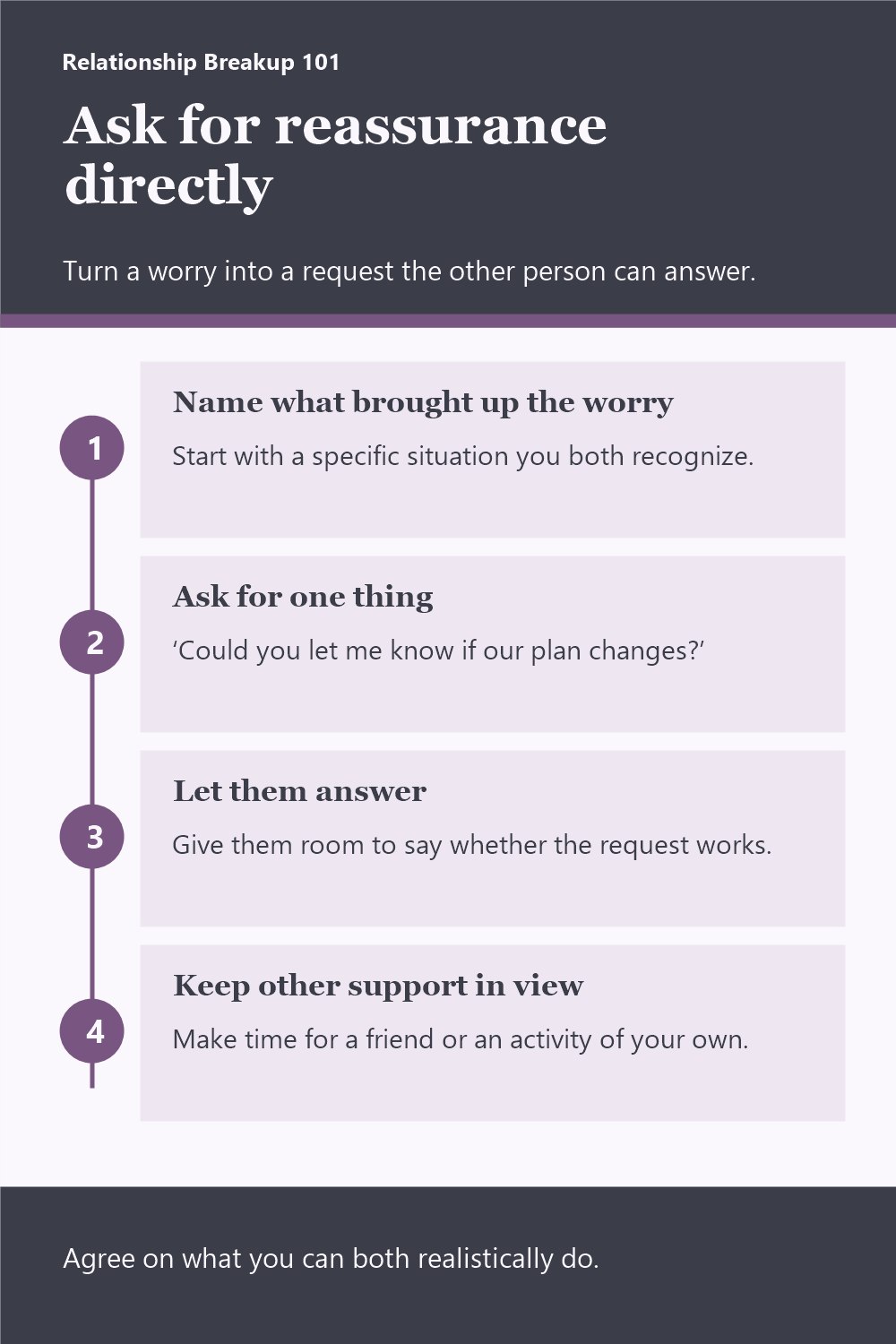
Ask for reassurance directly Turn a worry into a request the other person can answer.
- Name what brought up the worry Start with a specific situation you both recognize.
- Ask for one thing ‘Could you let me know if our plan changes?’
- Let them answer Give them room to say whether the request works.
- Keep other support in view Make time for a friend or an activity of your own.
Agree on what you can both realistically do.